RFID hardware is bought on spec lines: band, conducted power, antenna gain, chip memory, IP rating. This hub maps the whole catalogue — UHF readers in four form factors, antennas, passive tags and labels, HF/NFC and LF credentials, wristbands, printer-encoders and active 2.4 GHz hardware — and explains what each spec line means, with typical ranges drawn from public datasheets and standards. Identium designs and manufactures its UHF readers, antennas and tags in-house, configures FCC-band and ETSI-band reader variants per order and quotes in USD from EXW to DDP. Pick a category, then paste the RFQ checklist into your enquiry.
Every RFID system is the same chain: a reader generates RF, an antenna shapes it, a tag or credential answers, and software turns reads into events. Each card links down to the category page that breaks out every spec line with sourced typical values.
Passive UHF (RAIN, ISO/IEC 18000-63) readers inventory many tags at once over metres. They come as fixed, integrated, handheld and desktop units; the parent UHF RFID readers page compares them side by side.
Panel, wide-beam patch and near-field antennas set the read zone; the coax sets the loss. Sourced circular-polarised antennas run from 3.2 dBic at a 100° beam to 11.5 dBic at 40°. Full ladder on RFID antennas.
A passive tag is a chip, an antenna and its surround. Labels and inlays serve retail and logistics, on-metal tags add a spacer for conductive surfaces, and UHF RFID tags covers hard, laundry, windshield and livestock formats.
Credentials run at 13.56 MHz (ISO/IEC 14443, ISO/IEC 15693, NFC), at 125 or 134.2 kHz LF, or at UHF for hands-free gates. Browse RFID cards, RFID wristbands and HF and NFC RFID for chips, bodies and closures.
Thermal-transfer printers with a built-in UHF encoder print the label face and write the chip in one pass, then verify the write. Desktop and industrial classes, resolutions and media rules are compared on RFID printers.
Battery-powered tags beacon on their own and readers listen, which suits people and vehicle presence over tens of metres. Active RFID hardware explains beacon interval, battery life, omni and directional readers, and site-survey ranges.
Form factor follows the read point: fixed for portals and conveyors, integrated for single lanes, handheld for counts and exceptions, desktop for encoding and service counters. The table pulls typical envelopes from public datasheets; treat any range as a vendor’s nominal figure until a site test confirms it.
Two, four or eight monostatic RP-TNC or SMA ports; 10–33 dBm conducted on PoE+ in the FCC band (31.5 dBm in the ETSI lower band) and 30 dBm on 802.3af PoE; opto-isolated GPIO from 2 in/3 out to 4 in/4 out for photo-eyes and stack lights. Hubs add eight outputs each, so one 4-port reader reaches 32 zones — the backbone of a warehouse system.
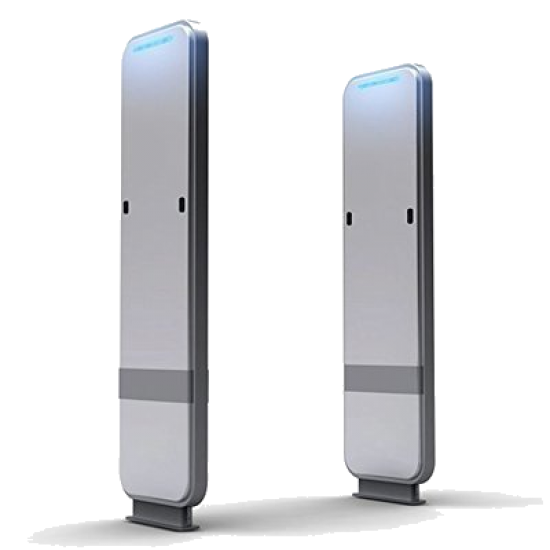
Gate and lane units put an 8.5–9 dBic circular antenna inside an IP65–IP67 housing, often with one to three extra ports and RS-485 or Wiegand output for barriers; indoor flat panels run IP20. In one flat-panel family the 8 dBic variant is rated 5 m at +30 dBm ERP and 7 m at +33 dBm ERP.
Gun-grip Android handhelds and Bluetooth sleds that clip to a phone. Vendor nominal ranges run from 6 m for an entry sled through 12 m standard to 29 m for long-range units; sealing runs from IP54 to dual-marked IP65/IP67, with drop ratings of 1.2–1.8 m to concrete.
USB readers for encoding, ticketing and point-of-sale checks. Short-range units run 0–9 dBm for 10–80 cm, a 100 mW unit reads about 1 m, and USB HID keyboard emulation lets the reader type each EPC into a host application as keystrokes.
| Form factor | Antenna arrangement | Typical RF power | Typical sealing | Vendor nominal range | Typical read point |
|---|---|---|---|---|---|
| Fixed | 2, 4 or 8 external ports; up to 32 zones via hubs | 10–33 dBm conducted on PoE+ (FCC band); 31.5 dBm ETSI lower band; 30 dBm on 802.3af PoE | IP50–IP53 indoor; IP67 rugged outdoor class | Set by the antennas and tags chosen | Dock doors, conveyors, portals |
| Integrated | Built-in 8–9 dBic circular antenna plus 1–3 external ports | Up to 33 dBm conducted | IP65–IP67 outdoor; IP20 indoor panels | 5–7 m (8 dBic class); 0–15 m stated for a 9 dBi gate unit | Vehicle lanes, gates, single doors |
| Handheld | Integrated linear or circular antenna | 0–30 dBm; long-range sleds to 35.5 dBm EIRP | IP54; IP65/IP67 ultra-rugged | 6 m (entry sled) to 29 m (long-range) | Cycle counts, search, exceptions |
| Desktop | Internal antenna; optional SMA or RP-SMA external | 0–9 dBm (encoding) to 30 dBm (1 W USB) | IP20–IP41 indoor | 10–80 cm to 1.2 m internal; up to 10 m external | Encoding, ticketing, point of sale |
The band decides which reader, antenna tuning and tag you order, and each region sets its own power ceiling. Country-by-country detail is in RFID frequency bands by country.
ETSI EN 302 208 V3.4.1 (2023-12) gives interrogators four 200 kHz high-power channels centred at 865.7, 866.3, 866.9 and 867.5 MHz, at up to 2 W e.r.p. (33 dBm). Above 1 W e.r.p. the antenna beam-width must be 90° or less; from 500 mW to 1 W the limit is 180°.
G.S.R. 853(E) of 10 Dec 2021 exempts 865–868 MHz from licensing: 2 W e.r.p., channels of 200 kHz or less, interrogators on the same four channels at 865.7, 866.3, 866.9 and 867.5 MHz, and EN 302 208 as the reference standard. It supersedes the 2005 RFID rules.
47 CFR 15.247 allows 1 W peak conducted output for hopping systems using at least 50 channels, and conducted power steps down dB for dB once antenna gain exceeds 6 dBi — 30 dBm plus 6 dBi, or 4 W EIRP. Identium configures FCC-band and ETSI-band reader variants per order.
HF/NFC uses 13.56 MHz everywhere: ETSI EN 300 330 V2.1.1 (2017-02) allows 60 dBµA/m at 10 m for RFID and NFC, and 47 CFR 15.225 allows 15,848 µV/m at 30 m in 13.553–13.567 MHz. LF runs at 125 kHz or 134.2 kHz under ISO/IEC 18000-2:2009.
Active tags and beacons share 2,400–2,483.5 MHz, where ETSI EN 300 328 V2.2.2 (2019-07) limits RF output to 20 dBm (100 mW) e.i.r.p. ISO/IEC 24730-2:2012 defines a DSSS 2.4 GHz air interface for real-time locating systems built on beaconing tags.
Five spec lines account for most mismatched quotes. Each is defined here with a sourced example; how to read a UHF reader datasheet goes line by line.
dBm is power relative to 1 mW: 30 dBm is 1 W, 33 dBm is 2 W. ERP references a half-wave dipole and EIRP an isotropic radiator, 2.15 dB apart, so 2 W e.r.p. is about 3.28 W (35.15 dBm) EIRP. Europe and India write limits in e.r.p.; the FCC writes conducted power plus antenna gain.
dBi is gain over an isotropic radiator; dBic and dBiL name a circular or linear reference. One panel publishes 10.9 dBic and 8.2 dBiL for the same EU-band antenna, a 2.7 dB gap, so compare like with like. Higher gain means a narrower beam. Our gain-units guide converts between them.
Most tags are linear dipoles. A circular reader antenna reads them in any orientation at the cost of about 3 dB polarisation mismatch; a linear antenna of the same gain reads farther when tag orientation is fixed, as on a conveyor.
EPCglobal published the UHF Gen2 air interface in 2004 and Gen2v2 in 2013; datasheets cite it as EPC Gen2v2 / ISO/IEC 18000-63. Gen2v3 passed its first membership ballot in January 2025, adding Query X / Query Y tag selection and a Read-Var command for user memory; it is backward compatible, and readers mainly take a software update.
Quoted in dBm, and more negative is better: current fixed readers state −93 dBm typical. ISO/IEC 18046-2:2020 sets the method — the weakest signal at which the reader passes 90% of at least 100 consecutive tests. Sensitivity and throughput trade off by RF mode: reader-chip datasheets list each mode separately and the most sensitive mode is the slowest, so ask which RF mode each figure uses.
Installation lines decide whether hardware survives the site and talks to the host. Pair every IP digit with an operating-temperature range.
The first digit is dust (5 protected, 6 dust-tight); the second is water (5 = 6.3 mm jets, 6 = 12.5 mm jets, 7 = 30 minutes at 1 m, 8 = deeper immersion on manufacturer terms). Dual marking such as IP65/IP67 confirms both jet and immersion tests. Indoor readers cluster at IP50–IP53, outdoor units at IP65–IP67.
IEEE 802.3af delivers about 13 W at the device and 802.3at PoE+ about 25.5 W. Readers tie their conducted-power ceiling to that budget — in one datasheet 30 dBm on 802.3af and up to 33 dBm on PoE+ in the FCC band — and an outdoor unit drawing 25.4 W asks for a 30 W switch port, Cat 6 cable and a run of 100 m or less.
RF ports are 50 Ω RP-TNC or SMA. At 900 MHz, 400-grade coax loses about 0.13 dB per metre and RG-58 about 0.69 dB, so a 10 m run costs roughly 1.3 dB or 6.9 dB. Specify cable grade and length alongside the antenna.
RS-232 runs point-to-point to about 15 m; RS-485 is multidrop to 32 devices and 1,200 m at low baud rates; 26-bit Wiegand carries an 8-bit facility code and a 16-bit ID to an access-control panel. Ethernet hosts speak LLRP, TCP, HTTP or MQTT.
The chip sets memory and sensitivity, the antenna and surround set range on the target surface, and the body sets survival. Ask for every range with its surface and reader conditions.
Gen2 tags hold four banks: reserved (32-bit kill and access passwords), EPC, TID and optional user memory. Retail chips such as Impinj M730/M750 and NXP UCODE 9 carry 96–128-bit EPCs and read at −24 dBm; extended parts reach 496-bit EPC or 512-bit user memory. Write endurance runs from 10,000 cycles / 10 years to 100,000 / 20 years.
Inlay antennas run from 42 × 16 mm to 94 × 24 mm, delivered dry, wet or as printable labels. Read range changes with the surface the inlay sits on and its orientation to the reader antenna, so ask for each range figure with its surface, orientation and assumed reader power. Apparel retail programmes specify inlays by ARC spec letter.
Sourced on-metal ranges at 2 W ERP or with a fixed reader: 1–2 m for embeddable micro ceramics, 2.5–4.5 m for printable PET labels, about 10 m for plate tags and 18–20 m for large industrial tags, with handheld figures about half. IP68 depth and duration are manufacturer-defined, so request them for asset tagging.
ISO/IEC 7810 ID-1 cards measure 85.60 × 53.98 mm at 0.76 mm nominal. ISO/IEC 14443 chips read to about 10 cm, ISO/IEC 15693 vicinity chips to about 1 m, and UHF cards over several metres; 125 kHz LF chips serve proximity access and animal ID.
Body and closure follow wear time: Tyvek with tamper-evident adhesive for single-day events, vinyl with snap locks for stays of a week or more, silicone for reusable cashless and locker access, woven fabric with a locking bead for festivals. The chip — NTAG, MIFARE Ultralight, DESFire or UHF — sets range and security.
Two families sit at either end of the catalogue: printers that commission passive labels, and battery-powered tags that announce themselves on a timer.
One vendor family sizes its desktop encoder for about 2,500 labels a day and its industrial models for 5,000 and 10,000. Industrial 4-inch heads offer 203, 300 or 600 dpi at 104 mm print width; 6-inch models reach about 166 mm.
About 16 mm is the common minimum inlay pitch. RFID media is defined by inlay centre, inlay position and pitch, measured to the antenna leading edge with ±3 mm tolerance; tag calibration steps the label 1 mm at a time to find the encode position.
The printer writes, verifies, then prints. A label whose tag fails is overstruck with VOID and the data retried on the next label (one to ten attempts, three by default on one platform). State the destination band so the encoder ships configured for it.
Active tags beacon on a timer, and the interval drives battery life: one vendor rates the same coin-cell tag at 3 years on a 3-second beacon and 7 years on a 10-second beacon. Badge, disc, keychain, wristband and adhesive- or lug-mount asset formats are common.
Active readers report presence in a zone, proximity at choke points, or position where locators cover the whole area. Published ranges carry qualifiers — 20 m omnidirectional versus 80 m directional for one reader, ‘open field’ or ‘sight distance’ for tags — so working range is confirmed by site survey. See active reader tracking.
Paste these lines into your RFQ and the quotation comes back comparable across suppliers.
Choose passive UHF to read many tags at once over metres — pallets, cartons, apparel, assets, vehicles. Choose HF/NFC at 13.56 MHz for deliberate tap interactions such as access cards, cashless payment, library items and phone-readable tags; ISO/IEC 14443 reads to about 10 cm and ISO/IEC 15693 to about 1 m. LF at 125 or 134.2 kHz serves legacy proximity cards and animal ID. Choose active 2.4 GHz when people or vehicles must be detected over tens of metres without a deliberate read. The UHF vs HF vs NFC guide compares them in depth.
UHF readers are built per region. Europe and India use 865–868 MHz with four 2 W e.r.p. interrogator channels; the USA uses 902–928 MHz under 47 CFR 15.247; other countries set their own sub-bands. Identium configures FCC-band and ETSI-band reader variants per order, so state the destination country in the RFQ. HF/NFC at 13.56 MHz uses one carrier worldwide.
Yes. Identium’s UHF readers are BIS and WPC approved for India’s licence-free UHF band. For export orders the band variant is configured to suit the destination market.
Range depends on reader power, antenna gain, tag chip, surface and orientation. Ask for every tag range figure with the reader power it assumes — 2 W ERP equals about 35.15 dBm EIRP — and the surface it was measured on. Sourced on-metal figures run from 1–2 m for micro ceramics to 18–20 m for large industrial tags with a fixed reader, and vendor nominal reader ranges run from about 1 m for desktop units to 6–29 m for handhelds. The environment is the main source of lab-versus-field difference, so confirm with a site test.
Indoor readers and antennas typically sit at IP50–IP54; outdoor gates, lanes and yards call for IP65–IP67; tags exposed to washing or immersion are specified at IP68 or IP69K. Ask for the actual immersion depth and duration behind any IP68 figure (for example 1 m for 24 hours), and for dual marking such as IP65/IP67 wherever both jets and immersion apply.
Plain PVC is the lowest-cost body and suits direct-to-card printing, with vendor life estimates of about one year in daily use. PVC/PET composites resist heat and humidity and are quoted at 3–4 years; polycarbonate supports permanent laser engraving and is quoted at 5–10 years. Chip and inlay cards print best by retransfer, which calls for a heat-tolerant composite body.
Catalogue hardware is available from our online shop, India RFID Store. For project volumes, OEM/ODM builds, SDKs for Android, Windows and Flutter, or export pricing in USD on EXW, FOB, CIF or DDP terms, send the RFQ checklist to our sales team; the tender specification template helps for formal bids.
Tell us the destination country and the read point — we return the band variant, the antenna plan and a USD quotation with the conformity documents listed.