Passive UHF Tags · Inlays to Hard Tags

UHF RFID Tags
From Inlays to On-Metal and Specialty Formats

A passive UHF tag is a chip and an antenna, and the carrier around them decides what a buyer cares about: read range, the surfaces it tolerates, the temperatures it survives and the unit cost. This hub compares inlays, printable labels, hard tags, on-metal designs and specialty formats for laundry, windshields, livestock and jewellery, using sourced datasheet figures so spec lines compare on equal terms. Ready-stock formats are at India RFID Store; the full range sits under RFID hardware.
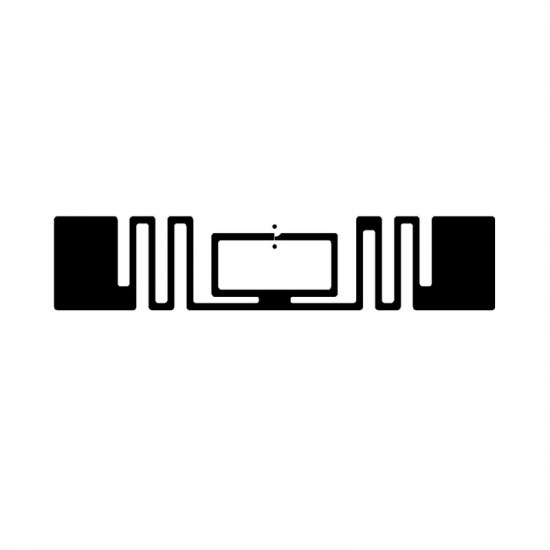
UHF RFID Tags: Inlays, Labels, Hard Tags & Specialty Tags by Use Case
Retail chip read sensitivity
−24 dBm
Current retail-class Gen2 tag ICs; write about −21 to −22 dBm
On-metal hard tag range
Up to 20 m
Heavy-industry tag on metal, fixed reader; up to 9 m handheld
Laundry tag endurance
300 cycles
Fabric-encased tag rated for 90 °C washing and 220 °C ironing
4memory banks in every Gen2 tag: Reserved, EPC, TID, User
2 W e.r.p.ETSI lower-band and India limit behind tag range curves
12%of maximum range with an inlay perpendicular to the antenna
100,000 / 20 yrwrite cycles and data retention on M770-class and UCODE 9 chips

Inlay, label, hard tag or on-metal: four build levels

Each build level adds material and process steps. The table compares sourced theoretical ranges; reel and converting detail continues at RFID labels and inlays.

layers

Dry and wet inlays

An inlay is chip and antenna on a substrate, such as a 10 µm aluminium antenna on 50 µm PET. A dry inlay adds a clear face without adhesive; a wet inlay adds adhesive on a release liner, the stock converters laminate into tickets, cards and labels.

tag

Printable labels

A label is a wet inlay under a printable paper or white plastic face. One thermal-transfer paper build is rated −18 to 82 °C in service, narrower than the chip’s −40 to +85 °C, so the face and adhesive set a label’s limits.

shield

Hard tags

A hard tag seals the inlay in PC/ABS or ceramic for IP68 sealing, mounting holes and peak-temperature tolerance; heavy-industry formats survive impacts above 25 kg from 1 m. Hard-tag datasheets quote fixed-reader and handheld ranges separately.

magnet

On-metal designs

Metal reflects RF and detunes a standard dipole, so on-metal tags add a foam, plastic or ferrite spacer and a retuned antenna. They come as 0.9–1.2 mm printable PET labels, hard tags and screw- or rivet-mount formats; detail at on-metal RFID tags.

FormatConstructionSourced read range (theoretical, 2 W ERP or fixed reader)Typical use
Dry / wet inlayAluminium antenna on PET; wet adds adhesive and liner11 m ETSI / 15 m FCC in free air (70 × 14.5 mm inlay)Labels, tickets, cards
Paper labelInlay under a printable face; 5.6 mil paper buildSurface-driven: cardboard 13 / 11 m, glass 7 / 2 mCartons, apparel, retail items
On-metal label0.9–1.2 mm white PET, resin-ribbon printable2.5–4.5 m on metalLabelled metal assets
Hard tagPC/ABS or ceramic, M3 or 6.5 mm fixing hole10 m (plate) to 18–20 m (flag, heavy-industry) on metalReturnable and heavy-industry assets
Micro / embeddable2.2–3.1 mm thick, epoxy-bonded or recessed1.5–4 m on metal; 1–1.5 m embeddedTools, instruments, small parts
LaundryFabric-encased, 1.0–1.7 mm, sewn or heat-sealed3 m to over 10 m (fixed reader)Linen, uniforms, workwear
Windshield0.2 mm tamper-evident label inside the glassUp to 8 m on glassVehicle ID, parking

Chip families, memory banks and endurance

The chip sets sensitivity, memory and endurance; the antenna and carrier set the rest. Buyers name chips because approved-inlay lists depend on them.

database

Four memory banks

Every Gen2 tag has Reserved memory (32-bit kill and access passwords), an EPC bank, a TID bank opening with class identifier E2h plus mask-designer ID and model number, and optional User memory. UCODE 8 and 9 factory-lock a 96-bit TID with a 48-bit serial. See our Gen2 memory guide.

cpu

Retail-class chips

Mainstream parts carry 96–128 EPC bits and 0–32 user bits: Impinj M730 (128/0), M750 (96/32), M770 (128/32), NXP UCODE 8 (128/0) and UCODE 9 (96/0), reading at −23 to −24 dBm. Endurance: 10,000 cycles and 10-year retention on M730/M750, 100,000 cycles and 20 years on M770 and UCODE 9.

lock

Extended and secure memory

For service or batch data: Impinj M780 (496/128) and M781 (128/512) at −23.5 dBm, NXP UCODE 9xm (128 + 752, 256 + 624 or 496 + 384 bits) and Alien Higgs-9 with a 688-bit user bank. Where a serial must resist cloning, NXP UCODE DNA adds hardware AES-128 per ISO/IEC 29167-10 at −19 dBm, and Impinj M775 adds authentication at −24 dBm.

code

Encoding and air interface

Encode to the current GS1 EPC Tag Data Standard (Release 2.3, covered in January 2026 for its new web-resolvable EPC schemes) and name the scheme, such as SGTIN-96, explained in our SGTIN-96 walkthrough. The air interface is Gen2 v2 / ISO/IEC 18000-63; the RAIN Alliance reported in January 2025 that a first Gen2v3 ballot had passed, and the protocol is backward compatible.

What sets read range

Range is a system property, and a tag datasheet fixes only its own side of it.

ruler

The 2 W ERP assumption

Range curves assume 35 dBm EIRP, equal to 33 dBm or 2 W ERP, the ETSI lower-band limit. Under the FCC 4 W EIRP limit add about 11%, with reader sensitivity then setting the ceiling. Our worked range calculation shows the arithmetic.

box

Surface material

One 70 × 14.5 mm inlay is rated 11 m (ETSI) / 15 m (FCC) in free air, 13 / 11 m on cardboard, 14 / 5 m on rubber and 7 / 2 m on glass. Region-specific tuning helps too: one on-metal tag reads 7 m as an EU version and 5 m (EU) as a global part.

rotate-cw

Orientation and reader

Range drops to 12% of maximum with an inlay perpendicular to the reader antenna. Circularly polarised reader antennas are used to read linearly polarised tags in any orientation, accepting a 3 dB polarisation mismatch. One test lab notes a 6 dB sensitivity swing halves range, so the same tag reads differently on fixed and handheld readers.

globe

Regional band

India’s licence-free UHF band is 865–868 MHz under G.S.R. 853(E) of 10 December 2021: 2 W e.r.p. on four channels of 200 kHz or less at 865.7, 866.3, 866.9 and 867.5 MHz, with EN 302 208 as reference. India mirrors the ETSI lower band, so ETSI-tuned tags serve both; see frequency bands by country.

Specialty tags: laundry, windshield, animal and jewellery

Each specialty format answers one demanding test; these sourced figures belong in the RFQ.

shirt

Laundry and textile

A 50 × 16 mm fabric-encased tag, 1.0 mm thick (1.7 mm at the chip module), is rated for 300 cycles including 90 °C washing, a 185 °C tunnel finisher, 220 °C ironing and a 60 bar extractor press, reading up to 3 m at 2 W ERP. A 75 × 15 mm textile tag quotes 200 cycles and over 10 m with a fixed reader. See RFID laundry management.

car

Windshield labels

A 92 × 26 × 0.2 mm non-transferable, tamper-evident label bonds inside the glass, so it stays with the vehicle. Theoretical range is up to 8 m on the windshield at 2 W ERP, or 10 m (ETSI) for a cryptographic version. Used in RFID vehicle and parking systems.

paw-print

Animal ear tags

Mandated animal ID runs on LF at 134.2 kHz under ISO 11784 and ISO 11785. UHF ear tags add group reading: in government pilots a four-antenna reader over a 2.75 m alleyway read 99.6% of free-moving cattle. One ear-tag design couples antenna and chip inductively, with no intermetallic connection between them, for ruggedness. See RFID livestock tracking.

gem

Jewellery loop labels

A loop label pairs a 28 × 15.875 mm printable face with a 35 × 0.5 mm tail that wraps a ring shank or chain, on UCODE 9 silicon. Its maker lists read distance as “testing recommended”, so trial on the real display. See RFID jewellery management.

Choosing by surface and environment

Pick the carrier for the worst surface and harshest process, then the chip for memory and security. Credentials people carry move to RFID cards, wristbands or HF and NFC.

wrench

Metal surfaces

Sourced on-metal classes (theoretical): micro and embeddable tags 1.5–4 m on metal (1–1.5 m embedded in metal), printable PET labels 2.5–4.5 m, small hard tags 4–7 m, plates 10 m and large flag or heavy-industry tags 18–20 m, with handheld figures roughly half. Mount on a large, even metal area with metal under the whole tag.

thermometer

Temperature: three numbers

Separate continuous range (chip-limited −40 to +85 °C), peak exposure (+130 to +140 °C for 10 min on hard tags; 225 °C for a high-temperature ceramic) and process profiles (90 °C wash, 135 °C sterilisation). One thermoplastic hard tag is tested to 235 °C peaks over 50 five-hour cycles.

droplets

Ingress protection

IEC 60529 (Ed. 2.2, 2013-08-29) defines 6 as dust-tight, 7 as 1 m immersion for 30 min and 8 as immersion under manufacturer-set conditions, so ask what IP68 means: published tags range from 1 m × 24 h to 5 h at 1 m.

anchor

Mounting

Adhesive (3M VHB or 300LSE, ideally applied at +21 to +38 °C); mechanical (M3 hole, slotted hole, single screw, rivets), preferred wherever mechanical stress is possible; epoxy or a machined recess for micro tags; sewing or heat-seal for textiles; polyurethane adhesive for high-temperature tags.

ARC specs, TIPP grades and end-use testing

Retail buyers specify performance thresholds and let approved inlays compete; our tender specification template turns this vocabulary into clauses.

award

ARC specs

Auburn University’s RFID Lab (ARC, founded 2009) benchmarks inlays against “Specs” set by use case, packaging, environment and infrastructure. One major US retailer maps apparel, footwear, accessories, watches and jewellery to Spec R and most boxed home goods to Spec Y2, with suppliers using approved-list inlays. See RFID apparel retail.

bar-chart

TIPP grades

GS1’s Tagged-Item Performance Protocol grades the tagged item rather than the inlay: S (single) or M (stacks of 2 or 11), a two-digit level in multiples of five and a family letter (B, V or D), giving grades such as S15B or M20D.

flask

Reels and testing

One 44 × 28 mm inlay ships 18,000 per reel dry, 15,000 wet or 3,200 as paper labels on 76 mm cores, and printer-encoders need about 16 mm minimum pitch. Inlay datasheets publish indicative curves and ask for end-use testing, so trial before ordering reels.

What to Put in the Enquiry

Paste these lines into your RFQ and the quotation comes back comparable across suppliers.

  1. Format: dry or wet inlay / label / hard tag / on-metal / laundry, windshield, ear tag or jewellery loop.
  2. Chip and memory: part name, EPC and user bits, TID serial, read sensitivity (dBm), write cycles and retention.
  3. Size: antenna and die-cut dimensions in mm; label face material, ribbon type and adhesive.
  4. Tuning: ETSI 865–868 MHz (Europe, India) / FCC 902–928 MHz / global; destination country.
  5. Target range on the real surface at 2 W ERP, fixed-reader and handheld stated separately.
  6. Environment: operating range, peak temperature, wash or sterilisation profile, IP rating with test depth and duration.
  7. Mounting: adhesive and application temperature / hole size / epoxy or recess / sewn or heat-sealed.
  8. Encoding: ARC Spec or TIPP grade; GS1 TDS release and scheme (e.g. SGTIN-96); lock and password policy.
  9. Commercial: pieces per reel, pitch, core; quantity, USD Incoterm (EXW / FOB / CIF / DDP), lead time.

UHF RFID Tag Types, Answered

What is the difference between an inlay, a label and a hard tag?

An inlay is chip and antenna on PET: dry without adhesive, wet with adhesive on a liner. A label is a wet inlay under a printable face. A hard tag seals the inlay in plastic or ceramic for IP68 sealing, mounting holes and heat tolerance; on-metal tags add a spacer and retuned antenna.

Which tag tuning should I order for India?

ETSI tuning. India’s licence-free UHF band is 865–868 MHz under G.S.R. 853(E) of 10 December 2021, at 2 W e.r.p. on four 200 kHz channels, mirroring the ETSI lower band. The Americas use 902–928 MHz; global-tuned parts cover both, sometimes with shorter range than region-specific versions.

How far will a UHF tag read?

Sourced theoretical figures at 2 W ERP: a 70 × 14.5 mm inlay 11–15 m in free air but 7 / 2 m on glass; on-metal PET labels 2.5–4.5 m; heavy-industry tags 20 m with a fixed reader and 9 m handheld. Treat each as a ceiling and test with the reader class you will deploy.

How much tag memory do I need?

A 96-bit EPC holds one SGTIN-96 identifier; 128-bit EPC chips leave room for longer schemes. Add user memory, up to 752 bits on configurable chips, when data must travel with the item. Choose a cryptographic chip (AES-128) when the serial itself must resist cloning.

Which tag should I use on metal?

An on-metal design: a spacer or ferrite layer and a retuned antenna keep it reading on conductive surfaces. Choose a 0.9–1.2 mm printable PET label (2.5–4.5 m) when you need print, or a hard tag for range and durability, mounted on a large, even metal area.

Does Identium take OEM orders and export?

Yes. Identium designs and manufactures UHF tags, cards and wristbands in-house, takes OEM/ODM orders, exports worldwide and quotes in USD on EXW, FOB, CIF or DDP terms. Use the RFQ checklist above; ready-stock formats are at India RFID Store.

Specify it once, quote it anywhere.

Tell us the destination country and the read point — we return the band variant, the antenna plan and a USD quotation with the conformity documents listed.