UHF vs HF vs NFC RFID: Choosing the Right Technology
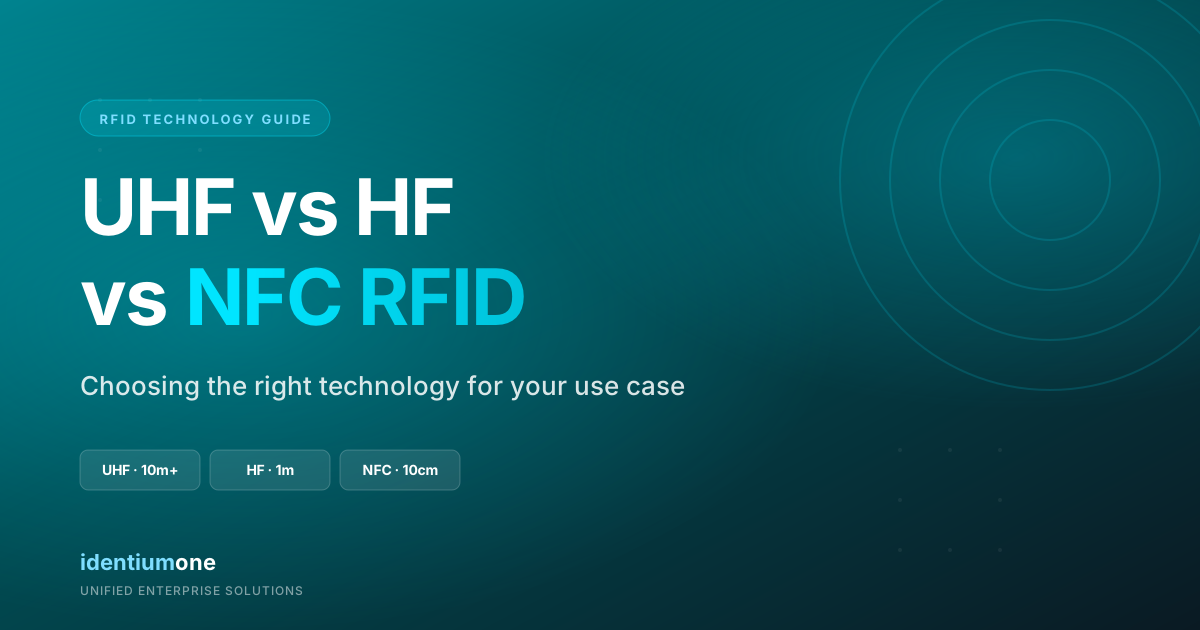
Every enterprise evaluating RFID runs into the same first question: which frequency? UHF, HF, and NFC each solve different problems — and picking wrong makes the difference between a smooth rollout and an expensive failure. This guide is an engineering-first comparison drawn from hundreds of deployments across India.
The three RFID frequency bands, in one table
| Property | LF (125 kHz) | HF (13.56 MHz) | NFC (13.56 MHz) | UHF (860–960 MHz) |
|---|---|---|---|---|
| Read range | ≤ 10 cm | 10 cm – 1 m | ≤ 10 cm | Up to 12 m |
| Read speed | Slow | Medium | Medium | Very fast (1000+/sec) |
| Tag cost | High | Medium | Low | Lowest (from ₹6) |
| Works near metal | Good | OK | OK | Needs on-metal variant |
| Works near liquid | Good | OK | OK | Challenging |
| Data security | Basic | Strong | Very strong | Basic + encryption options |
UHF: the workhorse for business scale
UHF RFID (860–960 MHz, governed by ISO 18000-63 / EPC Gen2) is the clear winner for any scenario where you need to count or track many items at a distance — warehouses, retail, logistics, asset tracking. Modern UHF readers can identify 1,000+ tags per second from up to 12 metres, which is why Walmart, Zara, and most large Indian retailers standardised on it.
The trade-off is that UHF doesn't play well with metal or liquids by default. But vendor-neutral solutions now include on-metal RFID tags and tags designed for steel-framed environments, so the limitation only bites in very specific niches.
If you're tracking anything on a pallet, in a carton, or on a shop floor — UHF is almost certainly the answer.
HF: the library and identity standard
High-Frequency RFID (13.56 MHz, ISO 14443 / 15693) reads at short distances — typically 10 cm to 1 metre — with very reliable performance in dense-tag environments. It's the global standard for library management, contactless smart cards, and identity applications because:
- Tag-on-tag reads are accurate (a stack of 30 library books at once)
- Stronger cryptography than basic UHF (MIFARE DESFire, for example)
- Global frequency — the same 13.56 MHz tag works in India, EU, US, anywhere
Downside: only ~1-metre range. So HF is not for warehouse-floor counting — it's for human-touch scenarios. For what that looks like in a working library — self-issue kiosks, security gates, annual stock verification — see our RFID library management guide.
NFC: phone-pocket RFID
NFC is technically a subset of HF (also 13.56 MHz). The difference is that every smartphone in the world can read it. That makes NFC the default for consumer-facing experiences: tap-to-pay, digital product passports, marketing engagement, loyalty. Passports are the one where the choice is genuinely contested — an Indian garment exporter has to weigh phone-readable NFC against the UHF inlay already in the hangtag and a plain QR code; our DPP guide for Indian exporters works through that trade-off.
If you want customers to interact with a tag using their phone — without an app or dedicated reader — you want NFC. But don't use NFC where an RFID reader is doing the work; UHF and HF are faster.
LF: the livestock-and-legacy band
LF (125 kHz) is largely legacy — still used for livestock ear tags, some access control cards, and car immobilisers. LF has good penetration through liquid and metal but very short range. Unless regulation mandates LF (as with ICAR-compliant livestock tags), new deployments skip it. Our guide to RFID livestock tracking in India covers which standard applies, how Pashu Aadhaar registration works, and where UHF is now displacing LF on farms.
A decision framework that actually works
Walk your use case through these four questions:
- How far do you need to read from? ≤ 10 cm → HF/NFC. 10 cm – 1 m → HF. 1–12 m → UHF.
- How many tags at once? 1 at a time → HF/NFC. Many at a time → UHF.
- What's the environment? Heavy metal/liquid → HF or on-metal UHF. Dry and airy → standard UHF.
- Will end-users scan with phones? Yes → NFC. No → HF or UHF depending on 1–3.
Practical examples
Warehouse pallet tracking → UHF (range, multi-tag speed). See our warehouse solution.
Hospital patient wristband → HF (close read, strong crypto). See our healthcare solution.
Event cashless payment → HF/NFC wristbands (close-range, phone-readable top-up). See our IDPay platform.
Retail inventory → UHF (hundreds of SKUs read per second). See our inventory solution.
Library book management → HF (tag-on-tag stacks, global standard). See our library solution.
Cattle ear tags → LF/UHF (ICAR mandate). See our livestock solution.
Office door access and attendance → HF/NFC cards (close read, strong crypto, no battery). See our access control and attendance solution.
Campus hiring and career-fair badges → HF/NFC (one tap per candidate at each round). See our recruitment management solution.
Still unsure? Default to UHF.
If you're building something new and your scenario isn't obviously HF/NFC territory, start with UHF. It has the strongest vendor ecosystem, the lowest tag cost per piece, and the most mature tooling. We stock a full UHF range at IndiaRFIDStore.com, and pair it with the Identium software stack for a turnkey deployment.
Want a conversation about your specific use case? Get in touch — we typically recommend a hardware mix within the first 15 minutes of a call.