ISO Card Formats · LF, HF, UHF, Dual

RFID Cards
LF, HF, UHF and Dual-Frequency in ISO Format

An RFID card is a chip and antenna laminated into a plastic body, and the chip’s band decides the job: 125 kHz proximity for attendance and doors, 13.56 MHz HF and NFC for secured access, payments and campus services, and UHF for hands-free reads at vehicle gates several metres away. This page sets out ISO/IEC 7810 sizing, chip families per band, sourced read ranges, printing and encoding, and dual-frequency builds that carry two technologies in one card. Ready-stock cards are at India RFID Store; the wider range sits under RFID hardware.
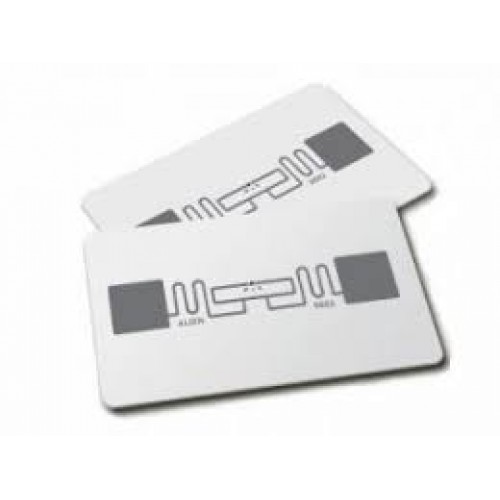
RFID Cards: UHF, HF (13.56 MHz), LF (125 kHz) & Dual-Frequency
ISO ID-1 (CR-80) card
85.60 × 53.98 mm
ISO/IEC 7810 outline at 0.76 mm nominal thickness
HF proximity read range
Up to 10 cm
ISO/IEC 14443 cards; set by reader field strength and antenna geometry
UHF card read range
Up to 9 m
EPC Gen2 ISO-format card with a matched long-range reader; site dependent
4card sizes in ISO/IEC 7810: ID-000, ID-1, ID-2 and ID-3
13.56 MHzone HF carrier for ISO 14443, ISO 15693 and NFC cards
125 / 134.2 kHzLF carriers for Type A and Type B tags in ISO/IEC 18000-2
EAL5+Common Criteria rating, hardware and software, of a current high-security HF card chip

ISO card sizes, bodies and companion standards

Most RFID cards follow the ISO/IEC 7810 ID-1 outline, so one card fits the printers, encoders and readers built around it. ISO/IEC 7810:2019, amended in 2024, is the current edition and covers materials, construction and dimensions.

credit-card

ID-1 / CR-80 outline

The ID-1 body is 85.60 × 53.98 mm at a nominal 0.76 mm (760 ± 80 µm) with a 2.88–3.48 mm corner radius; datasheets also write it as CR-80 or 30 mil ± 3 mil. UHF and combination cards in this outline are specified from 0.76 mm (30 mil) to 0.92 mm depending on the inlay, and some 125 kHz cards use a thicker 1.8 mm ABS body.

ruler

Four ISO/IEC 7810 sizes

The standard defines ID-000 at 25 × 15 mm, ID-1, ID-2 at 105 × 74 mm and ID-3 at 125 × 88 mm, all at the same nominal thickness. Thin flexible cards have their own standard, ISO/IEC 15457-1:2008, which sets their physical characteristics and principal sizes, and the same chips also ship as RFID wristbands and labels and inlays.

layers

Magstripe, embossing and contact chips

Many issued cards combine RFID with older card technologies. ISO/IEC 7811-2:2018 covers the low-coercivity magnetic stripe, its encoding and character sets; ISO/IEC 7811-1:2018 sets requirements for embossed characters, with test procedures in ISO/IEC 10373-1; and ISO/IEC 7816 contact chips appear alongside the antenna on dual-interface cards.

cpu

Dual-interface cards

A dual-interface card runs one chip through both a contact plate and an antenna. One university card conforms to ISO 7816 (T=0, T=1) and ISO 14443 Type A, with 40K EEPROM (36K user-available), Java Card 2.2.1, RSA keys up to 2048 bits and a PVC body with a glossy overlaminated surface.

LF, HF and UHF cards compared

The carrier frequency sets read range, data rate, security options and the reader a card needs. The table summarises sourced figures; the physics is covered in UHF vs HF vs NFC, and 13.56 MHz readers and tags sit under HF and NFC RFID.

key

125 kHz proximity (LF)

ISO/IEC 18000-2:2009 defines LF air interfaces below 135 kHz: Type A (FDX) tags at 125 kHz stay powered through the reply, while Type B (HDX) tags at 125 or 134.2 kHz store energy and reply in the field pause. EM4200-class card chips hold a 64, 96 or 128-bit code in laser-programmed ROM and read at up to 10 cm on standard readers, or up to 100 cm with a dedicated long-range LF reader.

radio

13.56 MHz proximity (ISO/IEC 14443)

Type A and Type B both run at 13.56 MHz from a 106 kbit/s base: A uses 100% ASK with Modified Miller coding, B uses 10% ASK with NRZ-L. Current editions are Part 1:2018, Part 2:2020, Part 3:2018 and Part 4:2018. Chip makers quote up to 100 mm, set by field strength and antenna geometry, a range suited to a deliberate tap at a door or till.

scan-line

13.56 MHz vicinity (ISO/IEC 15693)

Vicinity cards trade speed for range: passive cards can be energised up to 1 m from a coupler, with 26.48 kbit/s reader-to-card in 1-of-4 coding. A current ISO/IEC 15693 chip reaches up to 1.5 m gate width, holds 2,560 bits of user memory and adds EAS and AFI. Part 2:2019 and Part 3:2026 are the current editions.

car

UHF RAIN cards (860–960 MHz)

EPC Gen2 / ISO/IEC 18000-63 cards reach vehicle-gate distances: one 86 × 54 × 0.8 mm PVC/PETF composite card is rated up to 9 m with a matched reader at −40 to +70 °C, and a combination card in the same outline up to 7 m. Order ETSI tuning for 865–868 MHz regions, India included under G.S.R. 853(E) of 10 December 2021, and FCC tuning for 902–928 MHz; see bands by country.

smartphone

NFC cards and phones

NFC Forum devices read ISO/IEC 14443 A and B, ISO/IEC 15693 and JIS X 6319-4 cards at a typical range up to 2 cm, across five tag types. Type 2 tag chips offer 144, 504 or 888 bytes with a factory 7-byte UID, a 32-bit password and a UID mirror that serialises NDEF messages, so each card can carry a unique link a phone opens on tap.

BandStandardTypical card chipsSourced read rangeData / memoryCommon card uses
LF 125 kHzISO/IEC 18000-2EM4200-class read-only; T55x7-class programmableUp to 10 cm; up to 100 cm with a long-range LF reader64–128-bit factory codeAttendance, ID badges, doors
HF 13.56 MHz proximityISO/IEC 14443 A/BMIFARE Classic EV1, DESFire EV3, Ultralight, NTAG21xUp to 10 cm106–848 kbit/s; 144 bytes to 16 kBSecured access, closed-loop payment, ticketing, campus
HF 13.56 MHz vicinityISO/IEC 15693 (NFC Type 5)ICODE SLIX2 classUp to 1 m from a coupler; 1.5 m gate width per chip maker1.65–26.48 kbit/s; 2,560-bit user memoryLibrary and longer-range HF reads
UHF 860–960 MHzEPC Gen2 / ISO/IEC 18000-63UCODE 7/8, Monza 4QT, UCODE DNAUp to 7–10 m with a matched reader (vendor figures)Up to 128-bit EPC; 96-bit TID with 48-bit serialVehicle gates, hands-free access, events

Chip families and security levels per band

Two cards on the same frequency can differ widely in memory, cryptography and endurance, so an RFQ names the chip part as well as the band. Readers and back-office software are configured for specific chip families, which is why buyers specify them by name.

cpu

LF read-only and programmable chips

EM4200-class chips directly replace EM4100/4102 and EM4005/4105, support Manchester, Biphase, PSK and FSK encodings across 100–150 kHz and run from −40 to +85 °C; the reader’s encoding and bit format must match the card. Programmable T55x7-class chips suit schemes that write the LF number at issue.

database

MIFARE Classic EV1

1 kB or 4 kB EEPROM on ISO/IEC 14443-3 Type A at 106 kbit/s, CRYPTO1 security, a 4-byte NUID or 7-byte UID and 100,000 write cycles; the 1K map is 16 sectors of four 16-byte blocks. It remains widely deployed, and for security-relevant applications its maker points customers to the DESFire and Plus families.

lock

MIFARE DESFire EV3

The high-security HF card chip: ISO/IEC 14443 A parts 1–4, ISO/IEC 7816-4 APDUs, NFC Forum Type 4, 2/4/8/16 kB, hardware AES-128 alongside DES and 3DES options, Common Criteria EAL5+ for hardware and software, 25-year retention and typically 1,000,000 write cycles. Proximity Check counters relay attacks; listed uses include closed-loop payments, access management and transport ticketing.

tag

Ultralight and NTAG

MIFARE Ultralight targets low-cost, high-volume tickets and loyalty cards: EV1 with a 32-bit password, C with 112-bit 3DES, and AES with 128-bit AES and CMAC at CC EAL3+. NTAG213/215/216 add NFC Forum Type 2 compliance with 10-year retention and 100,000 write cycles for phone-readable cards and labels.

shield

UHF card chips

A typical UHF card chip carries up to 128-bit EPC, a factory-locked 96-bit TID with a 48-bit serial and 32-bit kill and access passwords; some add a read-range-reduction mode that shortens range for privacy. Cryptographic parts such as UCODE DNA add a 128-bit AES key, 224-bit EPC and 3,072-bit user memory at −19 dBm read sensitivity. Memory layout: Gen2 memory banks.

Dual-frequency cards: LF+HF, LF+UHF and HF+UHF

A dual-frequency card laminates two chips and antennas into one ISO body, so a single credential works with two reader families: typically a short-range tap at doors and tills plus either a legacy proximity read or a hands-free read at a lane.

git-branch

LF + HF: one card across two door generations

Pairing 125 kHz with 13.56 MHz lets one card open existing proximity readers while new doors use HF security. Current ranges pair a DESFire EV3 2K, 4K or 8K chip with a pre-coded 40-bit EM4200 or a programmable T55x7 chip in an 85.60 × 53.98 mm PVC card; an EM-compatible plus MIFARE 1K card reads up to 10 cm on both bands at 0.8 mm thick.

car

LF + UHF: door reader and vehicle gate

A UHF plus 125 kHz card carries a 128-bit EPC Gen2 chip (860–960 MHz), rated by its supplier at up to 10 m, and a 64-bit EM-compatible read-only chip for door readers at up to 6 cm, in an 86 × 54 × 0.8 mm PVC body rated −50 to +60 °C. One card then serves the barrier and the turnstile.

layers

HF + UHF: secure tap, long-range lane

HF smartcards operate under 10 cm and UHF over several metres. A chip maker’s white paper describes dual-frequency cards pairing short-range HF with long-range UHF while keeping existing HF readers. Built examples put a MIFARE 1K antenna and a Gen2 antenna on one inlay, or pair MIFARE Classic 1K or DESFire EV1 2K with a locked-EPC UHF chip rated up to 7 m.

printer

Printing two-chip cards

One 40% polyester / 60% PVC UHF credential rated up to 5 m names high-definition retransfer as its recommended print process. Specify the print method together with the card build, and test-print samples before the volume order.

Printing, encoding and card-body life

Printing and encoding at issue decide what artwork, numbering and data a card carries. Printer-encoder selection continues at RFID printers.

printer

Direct-to-card or retransfer

Direct-to-card printing sublimates dye straight onto plain PVC: faster and cheaper per card, with a thin white border. Retransfer prints onto a clear film that is heat-bonded to the card for over-the-edge coverage, higher image quality and more durable prints; it pairs with heat-tolerant composite card bodies rather than plain PVC.

gauge

Retransfer printer envelope

A current retransfer class prints 600 × 600 dpi over the edge at up to 150 cards/hour single-sided YMCK and 100/hour dual-sided, on ID-1 cards 0.76–1.25 mm (30–50 mil) thick in PVC, composite PVC, PET, PC or ABS, with a clear film rated at 1,200 prints per roll.

key

Encode in the same pass

Inline encoders print and encode in one pass: ISO 7811 magnetic stripe on tracks 1–3 at high and low coercivity, ISO 7816 contact stations and contactless ISO 14443 A/B, ISO 15693, MIFARE and DESFire. UHF EPCs can be written and locked on a desktop UHF reader. Record each chip UID or TID serial against the printed card number so a lost card can be blocked by number.

shield

Body life and overlaminates

One card maker quotes plain PVC at about one year, PVC/PET multilayer at 3–4 years with better resistance to UV, chemicals, heat, cold and humidity, and polycarbonate at 5–10 years with permanent laser engraving. A 0.6 or 1.0 mil polyester overlaminate raises abrasion resistance, often by a factor of ten or more.

Choosing a card by application

Match the band to the read the site needs, then the chip to the security the scheme needs. Battery-powered zone tracking of people is covered separately under active RFID hardware.

id-card

Attendance and ID badges

125 kHz proximity cards with a fixed factory code read at up to 10 cm and pair with standard attendance and door readers; HF cards with a 7-byte UID suit sites that also want NFC phone reads. Wiegand and RS-485 wiring is in the access-controller guide; systems at access control and attendance.

lock

Secured doors and campus cards

Where cards gate labs, offices or residences, DESFire EV3 adds AES-128, relay-attack Proximity Check and per-application transaction MACs, and a dual-interface card adds an ISO 7816 contact chip and Java Card platform on the same body. Library borrowing pairs a patron card with ISO 15693 item tags encoded to ISO 28560; see library systems.

ticket

Events, delegates and cashless

Ultralight-class chips target event ticketing and loyalty at high volume, DESFire EV3 lists closed-loop payments, and HF+UHF dual-frequency passes add a long-range read alongside the HF tap. Systems: delegate tracking and cashless payment; the same chips come in wristbands for multi-day wear.

car

Vehicle and parking access

UHF ISO cards read at several metres in a lane, and LF+UHF or HF+UHF builds let the same card open the pedestrian door. Gate antenna layout is covered under RFID antennas, systems at vehicle parking management, and windshield labels under UHF RFID tags as the fixed-to-vehicle option.

What to Put in the Enquiry

Paste these lines into your RFQ and the quotation comes back comparable across suppliers.

  1. Format: ISO/IEC 7810 ID-1 (85.60 × 53.98 mm); thickness 0.76 / 0.8 mm or other; body PVC, PVC/PET composite or polycarbonate.
  2. Band and standard: 125 kHz (ISO/IEC 18000-2) / 13.56 MHz ISO/IEC 14443 A or B / ISO/IEC 15693 / UHF EPC Gen2 ISO/IEC 18000-63 / dual-frequency pair.
  3. Chip part and memory: e.g. EM4200 or T55x7, MIFARE Classic EV1 1K, DESFire EV3 4K, NTAG216, ICODE SLIX2, UHF chip with EPC and TID bits.
  4. UHF tuning: ETSI 865–868 MHz (Europe, India) / FCC 902–928 MHz / global; destination country.
  5. Reader match: LF encoding and bit format, controller output (e.g. 26-bit Wiegand), HF key and application layout, target read range on the buyer’s reader.
  6. Encoding at supply: UID / TID list, pre-coded numbers, keys and applications, EPC scheme, lock and password policy.
  7. Printing: blank or pre-printed; direct-to-card or retransfer; front / back artwork, printed serial number, ISO/IEC 7811 magnetic stripe HiCo or LoCo, embossing.
  8. Durability: operating temperature range, expected service life in years, polyester overlaminate.
  9. Commercial: quantity, sample lot for an on-site read test, USD Incoterm (EXW / FOB / CIF / DDP), lead time.

RFID Cards, Answered

Which frequency should an access or attendance card use?

Match the readers already installed. 125 kHz proximity cards suit attendance and ID badges read at up to 10 cm; 13.56 MHz ISO/IEC 14443 cards such as DESFire EV3 add AES-128 security for doors and payments; UHF cards read at several metres for vehicle lanes. Dual-frequency cards carry two of these in one ISO body.

How far can an RFID card be read?

Range follows band and reader. Sourced figures: 125 kHz proximity up to 10 cm, or up to 100 cm with a dedicated long-range LF reader; ISO/IEC 14443 up to 10 cm; ISO/IEC 15693 up to 1 m from a coupler; UHF ISO cards up to 7–10 m with matched readers per vendor datasheets. Confirm with a sample test on site.

Can a smartphone read RFID cards?

NFC phones read ISO/IEC 14443 A and B, ISO/IEC 15693 and JIS X 6319-4 cards, typically within 2 cm. For phone reads, specify an NFC Forum Type 2, 4 or 5 chip such as NTAG21x, DESFire EV3 or an ICODE SLIX2-class part. 125 kHz and UHF cards pair with dedicated readers.

What does a dual-frequency card add over a single-band card?

One credential works with two reader families: LF+HF for sites moving from 125 kHz to secure HF, and LF+UHF or HF+UHF for a door tap plus a hands-free vehicle or lane read. Each side keeps its own chip and number, so the card number list should map both IDs to the holder.

Which HF chip suits a new secured-access scheme?

For security-relevant applications the chip maker points to DESFire and MIFARE Plus. DESFire EV3 offers hardware AES-128, Common Criteria EAL5+, Proximity Check against relay attacks and up to 16 kB. MIFARE Classic EV1 remains widely deployed where cards must match existing CRYPTO1 readers.

PVC, composite or polycarbonate: which card body should I order?

Plain PVC is the low-cost body for direct-to-card printing, quoted at about one year of use. PVC/PET composites tolerate retransfer heat and last 3–4 years per one card maker; polycarbonate supports laser engraving and 5–10 years. Add a polyester overlaminate where abrasion is heavy.

Which UHF tuning should cards for India use?

ETSI tuning. India’s licence-free UHF band is 865–868 MHz under G.S.R. 853(E) of 10 December 2021, at 2 W e.r.p. on four 200 kHz channels at 865.7, 866.3, 866.9 and 867.5 MHz, mirroring the ETSI lower band. The Americas use 902–928 MHz.

Specify it once, quote it anywhere.

Tell us the destination country and the read point — we return the band variant, the antenna plan and a USD quotation with the conformity documents listed.