A fixed UHF RFID reader is the always-on interrogator behind portals, dock doors, conveyors and vehicle gates: a sealed box with two to eight antenna ports (32 or more read zones through hubs), a PoE or DC supply, opto-isolated GPIO for light stacks and photo-eyes, and Ethernet, RS-485 or Wiegand to the host. This page explains each spec line — conducted power versus e.r.p., receive sensitivity per ISO/IEC 18046-2, hub-expanded zones, IP codes and regional band variants — with typical figures from published datasheets and the India, ETSI and FCC rules, so your RFQ returns comparable quotes.
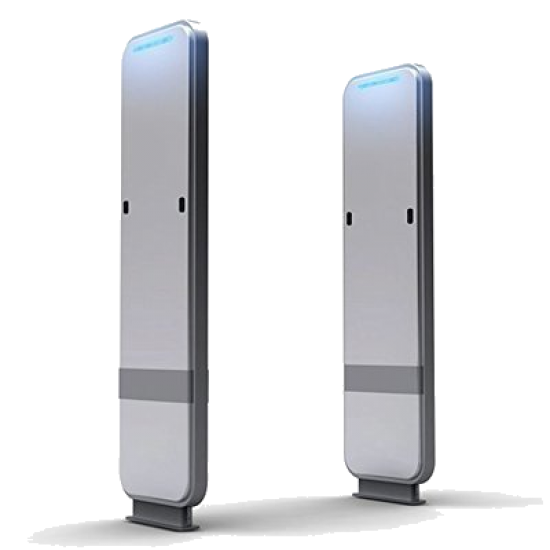
A fixed reader is bought as three line items — reader, antennas and coaxial cable — and installed once at a choke point. The choke point decides the reader class.
The reader feeds external antennas through 50 Ω coaxial ports; the antenna sets gain and beam-width, the cable sets loss. Portal panels run 8.3–9 dBic with 68–70° beams, while a 100° wide-beam patch gives 3.2–3.6 dBiC. The full ladder is on our RFID antennas page.
Most commercial portals stand two frames either side of the door, each carrying two to four circular antennas. One published layout for a 30 × 20 ft doorway uses a 4-port reader with two low side antennas and two overhead at 30 dBm. Start with our dock-door worksheet, then see how portals feed a warehouse management system.
Conveyor readers trade range for a tight, repeatable zone: narrow-beam antennas, reduced power and GPIO triggers from photo-eyes. PLC-oriented readers speak PROFINET, EtherNet/IP and OPC UA directly, which is how WIP tracking reaches the line controller.
Lane readers live outdoors: IP67 housings, M12 connectors, −20 to +55 °C and 4 in / 4 out GPIO to drive barriers and signals. Parking management runs the lane logic on top.
Choose a fixed reader when antennas must sit away from the electronics or several zones share one reader. Integrated readers put the antenna in the box for single-lane jobs, handhelds cover cycle counts, and UHF RFID readers compares every form factor.
Port count is the first filter. Each monostatic port feeds one antenna; hubs and multiplexers stretch one reader to 32 zones or more, at a cost in insertion loss and switching time.
Fixed readers use monostatic ports, transmitting and receiving on one antenna. Industrial units ship as 4- and 8-port RP-TNC variants, compact OEM boards use SMA, and outdoor lane readers pair R-TNC RF ports with M12 X-coded Ethernet.
One vendor’s 2026 family table spans 2 or 4 ports, 32.5–33 dBm maximum power and −84 to −93 dBm sensitivity. Four ports cover a portal with two antennas per side, or two conveyor stations; two ports suit a single lane or smart shelf.
An 8-port reader of about 2.13 kg, with 0 to +33 dBm per port on PoE+ or 24 V DC and 4 in / 4 out opto-isolated GPIO, can serve two four-antenna doors from one Ethernet drop — a natural fit for logistics cross-docks.
A reader-controlled hub adds eight outputs; four hubs on a 4-port reader give 32 zones. Third-party 16-port multiplexers cascade two levels to 1,024 antennas, switching in under 15 µs under GPIO control. Budget about 1.3 dB insertion loss per hub (34 dBm maximum input, 36 dB isolation) and roughly 25 ms per switch at device level: loss comes off range, and every zone in the round-robin shortens dwell time per antenna.
Datasheets quote conducted dBm at the port, regulators cap radiated power, and range depends as much on the receiver as on the transmitter.
EN 302 208 gives: conducted power = e.r.p. − antenna gain (dBic) + 5.15 + cable loss. At the 2 W (33 dBm) e.r.p. ceiling, an 8.5 dBic antenna on 1 dB of cable allows 30.65 dBm at the port. Work it through in our power-budget guide.
A 4-port enterprise reader offers 10–33 dBm on PoE+ (802.3at), limits itself to 30 dBm on standard PoE (802.3af) and to 31.5 dBm in the ETSI lower band. Current designs step power in 0.25 dB increments with 0.5 dB accuracy.
Current fixed readers quote −93 dBm typical (−94 ideal, −88 challenging) by the ISO/IEC 18046-2:2020 conducted method at 90% packet success; mid-range designs sit at −82 to −86 dBm and rugged outdoor units near −80 dBm. One test house maps −85, −75 and −65 dBm to roughly 25 m, 12 m and under 6 m in free space; a 6 dB difference halves range.
Headline figures of 1,100 to 1,300+ reads per second assume the fastest reader mode; one datasheet states its maximum applies only in mode 0 in an FCC-like region. In the sensitivity-optimised Miller M=8 mode, a top-tier reader chip reads 50+ tags/s. See how to read a reader datasheet.
At 900 MHz, 400-grade coax loses about 0.13 dB per metre, 240-grade 0.25 dB, 195-grade 0.36 dB and RG-58 0.69 dB. A 10 m RG-58 run costs about 6.9 dB against 1.3 dB for 400-grade — more than the 3 dB that PoE+ adds.
| Class | Antenna ports | Conducted power | Receive sensitivity | GPIO | Power input | Sealing & temperature | Weight / size |
|---|---|---|---|---|---|---|---|
| Compact OEM 4-port | 4 × SMA | +5 to +30 dBm; 2 W option to +33 dBm | Better than −84 dBm | 2 opto in; 1 relay out + 1 opto out | 9–12 V DC | −25 to +65 °C (sealing not given) | 329 g without antenna |
| Enterprise 4-port | 4 | 10–33 dBm on PoE+; 10–30 dBm on PoE | −93 dBm typical (ISO/IEC 18046-2) | 2 in / 3 out, opto-isolated | PoE / PoE+ | IP50, −20 to +50 °C | 0.96 kg |
| Mid-range 2/4-port | 2 or 4 × RP-TNC | 10–31.5 dBm on PoE+ or 12–48 V DC; 10–30 dBm on PoE | −82 dBm maximum | 2 in / 3 out, opto-isolated | PoE / PoE+, 12–48 V DC | MIL-STD-810G shock/vibration; −20 to +55 °C | 0.86 kg |
| Industrial 8-port | 4 or 8 × RP-TNC | 0 to +33 dBm on PoE+ / 24 V DC; 0 to +31.5 dBm on PoE | −86 dBm | 4 in / 4 out, opto-isolated | PoE / PoE+, 24 V DC | IP53, −20 to +55 °C | 2.13 kg |
| Rugged outdoor 4-port | 4 × R-TNC | +33 dBm (33 dBm e.r.p. ETSI / 36 dBm EIRP FCC) | −80 dBm typical | 4 in / 4 out, 30 V, 500 mA per output | PoE+ 802.3at, 25.4 W | IP67, −20 to +55 °C | 300 × 300 × 71 mm |
| Embedded-Linux retail 4-port | 4 × SMA | 5–31.5 dBm in 0.5 dB steps | — | 4 in, 8 out, relay | PoE 802.3af/at or 11–24 V DC; under 14 W | −20 to +40 °C, indoor | — |
The other half of the datasheet decides whether the reader fits your switch, your light stack and your controller.
IEEE 802.3af (2003) delivers 15.4 W at the switch and about 13 W at the device; 802.3at PoE+ (2009) 30 W and 25.5 W; 802.3bt 51 W or 71.3 W at the device over four pairs. A 25.4 W outdoor reader asks for a 30 W static-mode port, Cat 6 and no more than 100 m of cable; DC inputs run 12–48 V or 24 V.
Compact readers give 2 in / 3 out, industrial units 4 in / 4 out, embedded-Linux designs 4 in / 8 out plus a relay. Opto-isolated inputs accept 0–30 V (logic 1 at 3–30 V, logic 0 at 0–0.8 V); outputs switch up to 30 V and 500 mA each. Enterprise designs add a +5 V auxiliary of up to 500 mA for sensors or hubs, and one outdoor design powers its GPIO internally from the DC input, so state the supply mode in the RFQ.
10/100 Ethernet is standard, current enterprise readers add Gigabit, and outdoor units carry dual M12 ports. Host options run from LLRP to HTTP, MQTT, SQL, TCP and USB HID keyboard emulation on embedded-Linux readers, while PLC-class units speak PROFINET, EtherNet/IP and OPC UA.
RS-232 is point-to-point, typically about 15 m at 19,200 baud. RS-485 is differential multidrop: 32 driver/receiver pairs, 1,200 m at low baud rates and about 400 m at 115.2 kbps, on terminated 120 Ω twisted pair.
The 26-bit frame carries a parity bit, an 8-bit facility code, a 16-bit ID and a closing parity bit — 256 facility codes and 65,536 IDs — one way, over about 90 m on 24 AWG or 150 m on 18 AWG. Wiring for access control is in our Wiegand and RS-485 guide.
The IP code and the operating temperature say where a reader may live, and both are easy to over- or under-specify.
IEC 60529 (Ed. 2.2, 2013-08-29): first digit 5 = dust-protected, 6 = dust-tight; second digit 4 = splashing, 5 = 6.3 mm nozzle jets, 6 = 12.5 mm powerful jets, 7 = immersion to 1 m for 30 min. Jet and immersion tests are separate, so dual marking (IP65/IP67) shows both were passed.
Enterprise and mid-range readers for distribution centres sit at IP50–IP53, −20 to +50/55 °C and 0.86–2.13 kg. Mount them in a cabinet or above the door and let IP54–IP67 antennas face the weather.
Lane and yard readers are IP65–IP67 with M12 connectors, −20/−25 to +55/+70 °C and 2.5–4.3 kg; one rugged 4-port design measures 300 × 300 × 71 mm. PLC-oriented units pair IP65 with −25 to +55 °C on 24 V DC.
Mid-range readers cite MIL-STD-810G for shock and vibration and UL 2043 for air-handling (plenum) spaces, with EMC references FCC Part 15, EN 302 208 and EN 301 489-1/3. Antenna hubs are rated IP52 and −40 to +80 °C.
A fixed reader is configured for one regulatory region at a time. These are the rules each regulator sets; the variant you order is how the reader meets them.
G.S.R. 853(E) of 10th December 2021, which supersedes the 2005 RFID rules, allows interrogators 2 W e.r.p. in channels of 200 kHz or less, only on the four channels centred at 865.7, 866.3, 866.9 and 867.5 MHz. Continuous transmission on a channel is capped at 4 s with at least 100 ms between bursts. The reference standard is EN 302 208, so India mirrors the ETSI lower band.
EN 302 208 V3.4.1 (2023-12) sets the same four 200 kHz channels at 2 W e.r.p. (33 dBm) in 865–868 MHz, plus 915–921 MHz with 400 kHz channels at 916.3, 917.5 and 918.7 MHz up to 4 W e.r.p. (36 dBm). Above 1 W e.r.p. in the lower band, antenna beam-width must be 90° or less.
47 CFR 15.247 requires at least 50 hopping channels when the 20 dB bandwidth is under 250 kHz, no more than 0.4 s on any channel in a 20 s period, and 1 W peak conducted power with antennas up to 6 dBi; gain above 6 dBi comes off conducted power dB for dB.
Readers ship as distinct Global 902–928 MHz, ETSI 865–868 + 915–921 MHz and Japan 916.7–920.9 MHz models, or select 20+ national sub-bands by channel mask. Datasheets cite EPCglobal UHF Gen2 v2 / ISO 18000-63. Gen2v3 had passed its first membership ballot when the RAIN Alliance announced it on 30 January 2025, is backward compatible and mainly needs reader software updates. Check export certification by market.
We design and build our UHF readers and their software in-house in New Delhi, quote in USD on EXW, FOB, CIF or DDP terms, take OEM/ODM builds and ship SDKs for Android, Windows and Flutter. Our UHF readers are BIS and WPC approved for India’s licence-free UHF band, and FCC-band and ETSI-band variants are configured per order.
Work from the read point back to the reader; the RFQ checklist below turns each pass into lines a vendor can answer.
List every door, lane and station and the antennas each needs; most commercial portals carry two to four per side. Divide by ports. Where zones are many and sequential, such as shelves or cabinets, a hub or multiplexer extends one reader instead of adding a second.
Take the regional e.r.p. ceiling, subtract antenna gain and add cable loss to get the port power you need, then confirm the reader reaches it on your PoE class. Compare sensitivity only between ISO/IEC 18046-2 figures in the same RF mode.
Cabinet or above-door: IP50–IP53. Washdown bays and yard lanes: IP65–IP67 with M12 connectors. Check the temperature range against site extremes and the weight against the bracket.
Paste the checklist below into your RFQ, pair the reader with tags from our UHF RFID tags page, and see ready-to-ship readers in the India RFID Store UHF readers category. Antennas, cable and tags sit in the RFID hardware catalogue.
Paste these lines into your RFQ and the quotation comes back comparable across suppliers.
One per monostatic port when cabled directly: two, four or eight. A reader-controlled hub adds eight outputs, so four hubs on a 4-port reader give 32 read zones, and third-party 16-port multiplexers cascade two levels to 1,024 antennas. Budget about 1.3 dB of insertion loss per hub and roughly 25 ms per switch at device level, because every zone added to the round-robin shortens dwell time per antenna.
It is running on standard PoE. An 802.3af port delivers about 13 W at the device, and enterprise 4-port readers limit transmit power to 30 dBm on that budget; 802.3at PoE+ (25.5 W at the device) unlocks the full 10–33 dBm. In the ETSI lower band the same reader is further capped at 31.5 dBm. Ask for a PoE+ switch port or use the DC input.
G.S.R. 853(E) of 10th December 2021 allows interrogators 2 W e.r.p. in the 865–868 MHz band, in channels of 200 kHz or less, only on the four channels centred at 865.7, 866.3, 866.9 and 867.5 MHz, with at most 4 s of continuous transmission and at least 100 ms between bursts on a channel. The reference standard is EN 302 208. Convert e.r.p. to port power with our power-budget guide.
Our UHF readers are BIS and WPC approved for India’s licence-free UHF band. For export we configure FCC-band and ETSI-band variants per order, and export certification by market lists what each destination’s regulator asks for.
Regulators cap radiated power, so two compliant readers at the ceiling radiate the same e.r.p.; receive sensitivity is where they differ. One test house maps −85, −75 and −65 dBm readers to roughly 25 m, 12 m and under 6 m in free space, and a 6 dB difference halves range. Compare figures only when both use the ISO/IEC 18046-2 method (90% success over at least 100 tests) in the same RF mode.
RS-485: it runs about 400 m at 115.2 kbps and 1,200 m at low baud rates on terminated 120 Ω twisted pair. RS-232 suits runs of about 15 m at 19,200 baud, and Wiegand about 90 m on 24 AWG or 150 m on 18 AWG. Outdoor reader datasheets limit a PoE+ run to 100 m of Cat 6, so at 300 m power the reader locally from DC and add a switch or fibre if the site also needs Ethernet.
Order by destination. Vendors ship separate Global 902–928 MHz, ETSI 865–868 + 915–921 MHz and Japan 916.7–920.9 MHz models, while some readers select 20+ national sub-bands by channel mask. The channel rules differ as well: FCC-band readers hop across at least 50 channels when channels are under 250 kHz wide, while India and the ETSI lower band use four fixed 200 kHz channels. Name the destination country in the RFQ so the matching variant is configured.
Tell us the destination country and the read point — we return the band variant, the antenna plan and a USD quotation with the conformity documents listed.