USB Reader/Writers · 1 mW to 1 W

Desktop UHF RFID Readers
Encode, Issue and Test at the Desk

A desktop UHF RFID reader/writer sits beside a PC and does the close-range work of a RAIN RFID deployment: writing EPCs into new labels and cards, issuing badges and wristbands at a counter, checking tags on the bench, and typing an EPC straight into a spreadsheet. This page explains the category: output-power classes from 1 mW to 1 W, near-field versus far-field desk antennas, keyboard-wedge versus SDK control, Gen2 write, lock and kill, and the volume at which an RFID printer-encoder takes over. Every figure comes from a published datasheet or standard.
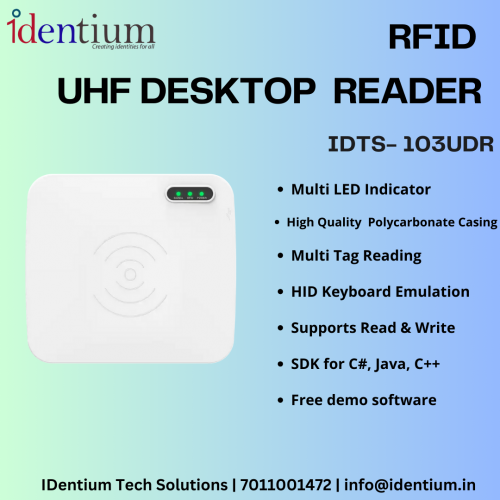
Desktop UHF RFID Readers & Writers: USB Encoding Stations
Encoding-class output
0–9 dBm
1–8 mW from a USB-C reader/writer, reading 10–80 cm depending on the tag (datasheet, Feb 2024)
Near-field read zone
0–7.5 cm
Desk antenna listed for encoding stations, with −20 dBi far-field gain to suppress stray reads
Write vs read threshold
−21 / −24 dBm
Retail-class inlay: writing needs about 3 dB more signal at the tag than reading
32-bitkill and access passwords, both held in a Gen2 tag’s Reserved bank
≤13 dBme.r.p. of an ETSI EN 302 208 Category III interrogator, the lowest power class
0.96 msfor a current retail tag chip to write 32 bits
2,500labels a day: the upper sizing one vendor gives its desktop RFID printer-encoder

What a desktop UHF reader/writer is for

A desktop reader is a short-range RAIN RFID interrogator powered and controlled over USB (serial or Ethernet on some units), built for one operator handling one item or a small batch. It runs the same EPC Gen2 v2 / ISO 18000-63 air interface as a fixed reader; what changes is the read zone, the host link and the write workflow.

pen-tool

Tag commissioning and encoding

Writing an EPC into blank labels, inlays, hard tags or cards before they enter service. Datasheets in this class list tag commissioning, EPC writing and programming individual goods or transponders at workstations as core uses, the first step of any asset register. EPC structure is covered in the SGTIN-96 encoding walkthrough.

id-card

Issuing cards, badges and wristbands

A counter where a UHF card or wristband is read, linked to a person in the database and handed over: delegate registration, staff badges, attendance enrolment. One HID-class desktop unit names ID badges and timecards for attendance and entry/exit records as typical work.

flask-conical

Bench testing and gate debugging

Checking what is written on a tag, confirming its TID, comparing tag samples before an order, or tracing why a portal misses an item. A current short-range USB-C unit names tag testing, EPC writing and UHF gate debugging as its main uses.

shopping-cart

Point of sale and document desks

Card-sized bus-powered readers list point of sale, information kiosks, document tracking and EAS at POS as application areas; workstation readers add sorting, picking and kanban refill control. Typical flows: file tracking and apparel retail checkouts.

Output power classes, from 1 mW to 1 W

Published desktop readers span three decades of transmit power. The lowest classes are deliberate: at a desk, a small read zone is what separates the tag under the operator’s hand from the box of blanks beside it.

gauge

Low power is the feature

A short-range USB-C reader/writer runs at 0–9 dBm (1–8 mW) and reads 10–80 cm depending on the tag. Under ETSI EN 302 208, an interrogator at or below 13 dBm e.r.p. is Category III, the lowest of its three power categories.

sliders-horizontal

Adjustable, separate read and write power

The 1 W USB class is command-adjustable from −5 to +30 dBm with ±1.0 dB accuracy and +20 dBm default, and holds separate read and write levels; a card-sized unit adjusts in 1 dB steps. The station can read at low power and still write with headroom.

radio

Internal antenna plus an external port

A +1 dBi internal antenna reads to about 1.2 m at full power, and an RP-SMA port takes an external antenna for up to 10 m. A workstation class with three SMA ports reads up to 50 cm internally and up to 4 m with external antennas.

plug

Bus power and the host’s USB budget

A 22 g card-sized reader draws 2.5 W from one port. The 1 W class draws up to 6.2 W through a cable ending in two USB-A plugs, the second for extra power, and applies duty-cycle limits above 23 dBm depending on temperature. Size the host’s USB supply accordingly, especially on tablets and thin clients.

Desktop classTransmit powerAntennaPublished read distanceHost link and power
Short-range encoder0–9 dBm (1–8 mW)Integrated circular patch10–80 cm by tag; about 40 cm with a typical tagUSB-C, virtual COM or HID; 5 V, max 350 mA with RF on
Card-sized, bus-powered+20 dBm (100 mW) ERP, 1 dB stepsIntegrated circular cross dipoleTypical up to 1 m; 200 tags/sUSB 2.0; 2.5 W
HID desktop / wall-mountMax 23 dBmIntegrated, circular10 cm to 5 m, adjustableUSB serial (VSP) and USB HID
1 W USB−5 to +30 dBm, separate read and write levels+1 dBi internal plus RP-SMA port1.2 m internal; 10 m with external antenna; 50 tags/sUSB 2.0 via two USB-A plugs; 6.2 W max
Workstation, multi-port50–500 mW, configurableInternal plus 3 × SMAUp to 50 cm internal; up to 4 m with external antennasRS232, USB or PoE Ethernet; LLRP; 7 W max
Near-field antenna on a reader port30 dBm input (33 dBm absolute max)Linear, −20 dBi far-field gain0–7.5 cmAny reader with a matching port

Near-field and far-field: shaping the read zone on a desk

UHF couples to tags in two ways. Close to a near-field antenna, the reader energises the tag mainly through its magnetic field; further out, the propagating wave powers the tag and the tag answers by backscatter. Desk antennas are designed for one regime or the other, and each datasheet states the zone its antenna is rated for.

magnet

Near-field desk antennas

A near-field reader antenna listed for high-speed encoding stations reads at 7.5 cm or less, with −20 dBi far-field gain to minimise stray reads and broadband 860–960 MHz coverage for every region. Its maker describes the short zone as virtually immune to liquids, powders and metallic packaging, which suits pharmacy, packaging and jewellery counters. Polarisation is linear, so tags are presented in a set orientation.

minimize-2

Low-gain and near-field integrated variants

In one flat-panel reader family, a −2 dBic low-gain variant is rated 1.5 m, and a 2 dBi near-field variant reads 0–20 cm in near field (0–40 cm at 1 W) and up to 2–3 m far field. The 8 dBic variant of the same housing is rated 5–7 m, the territory of an integrated reader at a lane.

scale

Modest sensitivity suits the desk

Reader chips come in sensitivity tiers; one family is rated −94, −88, −82 and −75 dBm. A current short-range USB-C reader/writer is built on the entry tier, a sound match when the tag sits centimetres away. Long-range sensitivity is the job of handhelds and fixed readers.

shield-check

Regulation at desk scale

ETSI EN 302 208 places no antenna beam-width restriction on lower-band interrogators at or below 500 mW e.r.p.; narrower beams are required only above that level. Desktop classes from 1 mW to 500 mW therefore sit in the least constrained part of the standard.

Keyboard wedge or SDK: how the reader talks to the PC

The host link decides how much software a desk station needs. A keyboard-wedge reader types the EPC wherever the cursor sits; an SDK-driven reader gives an application full control of read, write, lock and kill.

keyboard

USB HID keyboard emulation

In HID mode the reader enumerates as a keyboard and types each EPC into a spreadsheet, browser form or notes app with no driver or code. One HID desktop unit documents this mode for macOS and Android hosts and runs tag writing over its serial (VSP) mode, so HID fits read-and-record work such as stock checks and enrolment.

terminal

Virtual COM port and command protocols

In serial mode the reader exposes a virtual COM port and a command set. One short-range unit uses a plain AT protocol that an embedded PC or a PLC can drive; a 1 W USB unit uses a command-response protocol protected by a length field and 16-bit CRC. This is the mode encoding software uses.

code

SDKs and libraries

Desktop vendors ship libraries for Java, .NET and Python, or C/C++, .NET and Java, with USB drivers for Windows, Linux and Android. An SDK exposes per-command power, memory-bank addressing, access passwords and lock: the controls an encoding application needs. Identium supplies SDKs for Android, Windows and Flutter.

network

Ethernet, PoE, LLRP and buffering

Workstation-class readers come in RS232, USB or PoE Ethernet variants, support LLRP, and offer host, buffered-read, scan and notification modes, so one unit moves from a desk to a kiosk or self-service dispenser. A 1 W USB unit adds autonomous operation with a 200-tag buffer and 16 kB of memory.

Write, lock and kill: what the station does to a tag

Every Gen2 tag carries four memory banks. An encoding station writes some of them, protects others and records the rest; the Gen2 memory-bank guide covers the bit layout.

layers

Four memory banks

Reserved (MB 00) holds two 32-bit passwords, kill and access. EPC (MB 01) holds the item identifier. TID (MB 10) begins with the E2h class identifier, and its first 32 bits are permalocked at manufacture. User (MB 11) is optional storage that the chip may or may not implement.

file-pen

Writing the EPC

GS1 leaves encoding and overwrite protection to the user. Name the GS1 EPC Tag Data Standard release and the encoding scheme (for example SGTIN-96) in the encoding specification, so every station on every site writes identically.

lock

Access password and lock

The access password moves a tag between the Open and Secured states; from Secured, the station locks or permalocks memory so the EPC stays as written in the field. Industrial chips add BlockPermalock on user memory, and one HID desktop unit lists read, write, lock and delete among its functions.

power-off

Kill

The KILL command renders a tag permanently silent, and the 32-bit kill password guards it against misuse. Where an item will ever need retiring, set and record a unique kill password at encoding time, stored in the back-end database against the TID.

zap

Writing needs more signal than reading

Tag chips are rated −24 dBm read and −21 dBm write on a retail-class inlay, −23 / −18 dBm on another common chip, and −19 / −11 dBm on a cryptographic chip. Separate read and write power levels close that gap without widening the read zone. One card-sized reader also supports AES tag authentication per ISO/IEC 29167-10.

repeat

Write endurance for test tags

Entry retail chips are rated 10,000 write cycles with 10-year retention; industrial and extended-memory chips 100,000 cycles with 20-year retention. Bench samples rewritten every day belong in the higher class.

Throughput for bulk encoding

Tag chips write in milliseconds, so a desk station’s output is set by handling, verification and the read zone rather than by the radio.

timer

Chip time versus handling time

A current retail chip writes 32 bits in 0.96 ms. The seconds go into picking up the item, placing it in the zone, confirming a single tag is present, writing, reading back and labelling it. Process design sets the hourly rate.

activity

Inventory rate is a different number

Published rates such as 200 tags/s for a card-sized reader or 50 tags/s for a 1 W USB unit describe reading a population, and they fall in sensitivity-optimised reader modes: one chip family drops from 1,000+ to 50+ tags/s. Anti-collision across up to 50 tags at once helps batch checks; encoding works tag by tag.

check-circle

Encode, verify, then release

Printer-encoders encode, verify the write and then print, voiding a label that fails and retrying the same data up to a set count (1–10, default 3). A desk workflow can copy that loop: write, read back EPC and TID, log the pair, then release the item.

printer

When a printer-encoder takes over

One printer vendor sizes its desktop RFID printer-encoder for up to 2,500 labels a day and its industrial units for 5,000–10,000, encoding inlays at a pitch down to about 16 mm. At those volumes an RFID printer-encoder or pre-encoded labels and inlays handle the run, and the desk station handles cards, hard tags, exceptions and reel sampling.

Choosing a desktop reader: band, sensitivity, environment

Once power class and host link are fixed, three datasheet lines separate one desktop reader from another. The reader selection guide covers the wider decision.

globe

Regional band per order

Desktop readers ship as ETSI-band or FCC-band SKUs (865–868 MHz or 902–928 MHz) or with selectable region tables. India’s licence-free band is 865–868 MHz under G.S.R. 853(E) of 10 December 2021, up to 2 W e.r.p. on four 200 kHz channels centred at 865.7, 866.3, 866.9 and 867.5 MHz, referencing EN 302 208. More in RFID frequency bands by country.

ear

Sensitivity needs a stated method

Receive sensitivity compares across vendors when measured to ISO/IEC 18046-2:2020, the RAIN Alliance method: the smallest signal at which the reader passes 90% of at least 100 consecutive tests, with the RF mode recorded. Reading a UHF reader datasheet walks through the line.

home

Indoor environmental envelope

Desktop readers and desk antennas are indoor equipment, rated IP20 to IP41 or simply “for indoor use only”, typically −20 to +55 °C (one short-range unit to +70 °C; one 1 W USB unit −40 to +60 °C). Sealed counters and outdoor kiosks call for an integrated reader instead.

git-branch

Desk, handheld or fixed

A desk reader serves one operator at one point. Shelf counts call for a handheld; doorways and conveyors for a fixed reader with antennas. The whole family is on UHF RFID readers, and 13.56 MHz cards and phones on HF and NFC RFID.

factory

Built in-house, configured per order

Identium builds its UHF reader hardware and software in-house, with Android, Windows and Flutter SDKs and OEM/ODM options. Its UHF readers are BIS and WPC approved for India’s licence-free UHF band, and FCC-band and ETSI-band variants are configured per order. Desktop units are listed on the online store; browse the wider RFID hardware range.

What to Put in the Enquiry

Paste these lines into your RFQ and the quotation comes back comparable across suppliers.

  1. Desktop UHF RFID reader/writer, EPC Gen2 v2 / ISO/IEC 18000-63; read, write, lock/permalock and kill available through the SDK.
  2. Regional SKU for the destination: ETSI lower band per EN 302 208, FCC 902–928 MHz per 47 CFR 15.247, or India 865–868 MHz per G.S.R. 853(E); state the region table loaded at dispatch.
  3. Transmit power range and step size in dBm, with separate read and write power levels; target read zone stated (for example under 10 cm for one-at-a-time encoding).
  4. Antenna: integrated circular or near-field, gain in dBic or dBi; external port type (SMA or RP-SMA) if a separate near-field antenna will be fitted.
  5. Host interface: USB HID keyboard mode and virtual COM / serial command mode, with the supported host operating systems listed for each mode.
  6. SDK and libraries (state languages, e.g. Java, .NET, Python, Android) with sample code for EPC write, access-password set, lock and kill.
  7. Power: USB draw in W with RF on and at idle; confirm one USB port powers the reader at full output.
  8. Receive sensitivity in dBm per ISO/IEC 18046-2:2020 with the RF mode stated; read rate quoted with the reader mode used.
  9. Encoding verification: read-back of EPC and TID after each write, with an exportable log (CSV) of TID-to-EPC pairs.
  10. Operating temperature range, IP rating, dimensions, cable length, warranty term and firmware update path.

Desktop UHF RFID Reader/Writers, Answered

What is a desktop UHF RFID reader used for?

It is a short-range reader/writer that connects to a PC, usually over USB, for work done at a desk or counter: writing EPCs into new labels, cards and hard tags, issuing badges and wristbands, checking what is encoded on a tag, and capturing EPCs into business software. Published units list tag commissioning, point of sale, document tracking, kiosks and gate debugging among their uses.

What read range should a desktop encoding reader have?

As short as the job allows. Encoding-class readers run 0–9 dBm (1–8 mW) for 10–80 cm depending on the tag, and near-field desk antennas read at 7.5 cm or less. A short, controlled zone keeps the write on the tag in front of the operator and away from blanks on the desk. Longer-range units (about 1–1.2 m on the internal antenna, up to 10 m with an external one) suit enrolment counters and kiosks.

Can a keyboard-wedge (HID) reader write tags?

HID mode is a read-and-type mode: the reader acts as a keyboard and types each EPC where the cursor is. Writing, locking and killing run over the reader’s serial or SDK mode. One HID desktop unit, for example, writes tags through its serial (VSP) mode. For an encoding station, specify a reader with both modes and an SDK.

Why does a tag read correctly but fail to write?

Writing needs more signal at the tag than reading: a retail-class inlay is rated −24 dBm read and −21 dBm write, and a cryptographic chip −19 dBm read and −11 dBm write. Raise the write power level (readers with separate read and write levels do this without widening the read zone). If power is adequate, the memory may be locked, in which case the access password is required.

How many tags per hour can a desktop station encode?

The chip is rarely the limit: a current retail chip writes 32 bits in 0.96 ms. Hourly output depends on handling, placement, read-back verification and labelling. When volumes approach the range one printer vendor assigns to its desktop RFID printer-encoder (up to 2,500 labels a day), a printer-encoder or pre-encoded labels become the efficient route, with the desk station kept for cards, hard tags and exceptions.

Do I need a different desktop reader for India, Europe or the US?

Desktop readers are supplied as regional SKUs or with selectable region tables. Europe uses the ETSI EN 302 208 lower band, the US uses 902–928 MHz under 47 CFR 15.247, and India uses 865–868 MHz under G.S.R. 853(E) of 10 December 2021, which references EN 302 208. State the destination country in the order so the reader ships configured for it.

Is a desktop UHF reader the same as an NFC desk reader?

They are different technologies. UHF RAIN readers work at 860–960 MHz with EPC Gen2 tags; NFC and HF readers work at 13.56 MHz with ISO/IEC 14443 or 15693 tags. One common ISO/IEC 14443 credential chip is rated for an operating distance of up to 100 mm, depending on the reader’s power and antenna geometry. Dual-frequency cards carry both technologies, so an issuing desk may need one reader of each type; see HF and NFC RFID.

Specify it once, quote it anywhere.

Tell us the destination country and the read point — we return the band variant, the antenna plan and a USD quotation with the conformity documents listed.