HF, NFC & UHF · Single-Use to Reusable

RFID Wristbands
Matched to Wear Time, Chip and Reader

An RFID wristband is a chip and antenna sealed into something people wear for an hour, a weekend or a hospital stay. The band material and closure set how long it lasts and whether it can be re-issued; the chip sets the reader, the security and the read distance. This page compares silicone, spunbond HDPE, vinyl and woven fabric bands, HF/NFC, UHF and dual-frequency chips, and the printing and encoding steps, using sourced figures. Stock bands are at India RFID Store; the full range sits under RFID hardware.
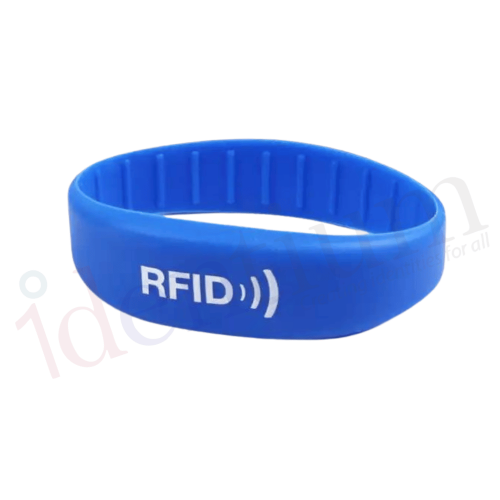
RFID Wristbands: Silicone, Disposable, Fabric & Dual-Frequency Bands
HF / NFC read distance
Up to 100 mm
Chip-maker operating distance for NFC Type 2 and DESFire-class ICs, set by reader field strength and antenna geometry (NXP)
Cashless-grade chip security
CC EAL5+
Common Criteria level published for MIFARE DESFire EV3, with hardware AES-128 and Proximity Check against relay attacks (NXP)
MRI and CT study
1.5 T & 3 T
13.56 MHz RFID transponders (the kind used in patient wristbands) kept their data after MRI and CT scanning; findings specific to the tags tested (Steffen et al., 2010)
13.56 MHzHF / NFC carrier for cashless, ticketing and patient bands (ISO/IEC 14443 and 15693)
1.5 mgate width up to which an ICODE SLIX2 vicinity tag reads, depending on antenna geometry (NXP)
860–960 MHzUHF Gen2 range; bands are tuned for ETSI 865–868 or FCC 902–928 MHz per destination
4core identifiers on an NHS patient band: last name, first name, date of birth, NHS Number (NPSA, 2007; Wales adds the first line of address)

Band material and closure decide wear time

Four body materials cover almost every order, and the closure is the security feature: it decides whether a band can change hands. Patient bands add a fifth, rule-driven case.

ticket

Spunbond HDPE (Tyvek) — single-use

Tyvek is 100% synthetic high-density spunbond polyethylene: light and breathable, yet resistant to water, abrasion, bacterial penetration and ageing, tear- and puncture-resistant, and recyclable. RFID versions close with a tamper-evident adhesive tab that destroys the band on removal, which suits nightclubs, waterparks and day tickets.

lock

Vinyl and layered plastic — multi-day

Several stretch-resistant layers with a locking snap or socket-and-stud closure that opens only by cutting. One supplier rates these bands for over a week of wear, which is why hotels and resorts favour them for stay-length access.

circle

Silicone — reusable

100% silicone, latex- and lead-free, issued again and again for cashless food-and-beverage spend, gym doors and lockers. The tag is moulded inside and logos are laser-engraved or silk-screened. One silicone UHF band lists a 258 × 21 × 10 mm body, about 15 g, rated −40 to +80 °C.

shirt

Woven fabric — festivals and long events

A fabric band closed by an RFID slider, a locking bead, or a one-way barrel lock that grips the fabric and cannot be loosened. It carries the chip for cashless and access across multi-day festivals and large venues, with laser-cut serial numbers for blacklisting lost passes and woven UV threads for covert checks.

heart-pulse

Patient bands — rule-driven layout

Hospital bands follow national patient-ID rules first. The NPSA notice of 3 July 2007 for England and Wales sets the core identifiers (last name, first name, date of birth, NHS Number), a white band with black text (red with a white identifier panel for a known risk such as allergy) and printing from the hospital system at the bedside. An HF chip adds a machine-readable link to the same record.

HF/NFC to tap, UHF for hands-free, or both on one band

Frequency sets the read distance and the reader you install. HF sits at 13.56 MHz in both the European (EN 300 330) and US (47 CFR 15.225) rules; UHF bands are tuned per region — see RFID frequency bands by country and UHF vs HF vs NFC.

smartphone

ISO/IEC 14443 and NFC — the tap zone

Proximity chips (MIFARE, NTAG, DESFire) run at 13.56 MHz with an operating distance of up to about 100 mm, set by field strength and antenna geometry; NFC Forum gives a typical NFC range of up to 2 cm. The short zone is the feature: a payment or door responds only to the wrist presented to it. More on the HF and NFC page.

scan-line

ISO/IEC 15693 — the vicinity option

Vicinity tags (ICODE SLIX class, NFC Forum Type 5) extend the read zone beyond the tap distance, and ICODE SLIX2 reaches up to 1.5 m across a gate depending on antenna geometry. Range scales with antenna size, so confirm wrist-size performance on the reader you plan to use.

radio

UHF Gen2 — hands-free and group reads

UHF bands (ISO/IEC 18000-63) read at a distance and many at once through anti-collision; one silicone UHF band lists 2 m typical at 4 W EIRP. Passive tags are affected by liquids and metal, so on-wrist testing and antenna placement carry more weight than at HF. Readers are on the handheld and fixed UHF reader pages.

layers

Dual-frequency — one band, two jobs

A dual-frequency band carries an HF chip and a UHF chip on one wrist. The HF side works in the proximity zone of up to about 100 mm for payment or a secure door, and the UHF side reads hands-free at a distance for headcounts and crowd flow at session doors, so one band covers both the counter and the gate.

key-round

LF 125 kHz — legacy door and locker estates

Sites already running 125 kHz proximity readers can stay on them with an LF band that carries a factory ID code matched to the existing access controller. ISO/IEC 18000-2 covers LF air interfaces below 135 kHz; state the chip type your readers expect in the RFQ.

Chip choice: memory, security and the readers you already own

The chip decides what a reader can do with a band: pay, open, count or hand a link to a phone. Match it to the back end and the readers already fitted, then to cost per band. RFID cards use the same chip families, so one reader can serve both cards and bands.

shield

Closed-loop cashless calls for strong cryptography

DESFire EV3 offers 2–16 kB, hardware AES-128, Common Criteria EAL5+, 25-year retention, Proximity Check against relay attacks and Secure Unique NFC messages. Its product page lists closed-loop payments among its uses, and the MIFARE Classic page directs security-relevant applications to DESFire and MIFARE Plus. See IDPay cashless payment.

ticket

Limited-use tickets suit Ultralight

MIFARE Ultralight targets limited-use public transport, loyalty and event ticketing: EV1 with 48 or 128 bytes of user memory and a 32-bit password, C with 144 bytes and 112-bit 3DES, and an AES variant with 144 bytes, CMAC and CC EAL3+.

smartphone

Phone engagement suits NTAG

NTAG213/215/216 give 144, 504 or 888 bytes, a factory 7-byte UID, 32-bit password protection with an optional attempt limit, 100,000 write cycles and a UID ASCII mirror that serialises each band’s NDEF link, so one tap opens a personalised URL.

database

UHF memory and passwords

Gen2 chips carry a serialised TID, an EPC of 96–496 bits depending on the part, optional user memory, and a reserved bank with 32-bit kill and access passwords (some chips share one password). Encoding is covered in our Gen2 memory bank guide; chips are compared on UHF RFID tags.

Representative published values per chip family; read distances are chip-maker or band-datasheet figures, to be confirmed on the wrist with your own reader.
Chip familyAir interfaceMemorySecurityPublished read distanceTypical wristband use
MIFARE Classic EV1ISO/IEC 14443-3 Type A, 106 kbit/s1 kB / 4 kBCRYPTO1; 4-byte NUID or 7-byte UID10 cm on a MIFARE 1K card (reader-dependent)Existing MIFARE door and locker estates
MIFARE Ultralight EV1 / C / AESISO/IEC 14443 Type A, parts 1–348 or 128 bytes user (EV1); 144 bytes user (C, AES)32-bit password / 112-bit 3DES / 128-bit AES with CMACProximity classLimited-use event and transport tickets
NTAG213 / 215 / 216NFC Forum Type 2, ISO/IEC 14443 A144 / 504 / 888 bytes32-bit password, optional attempt limitUp to 100 mmTap-to-phone links, low-cost tokens
MIFARE DESFire EV3ISO/IEC 14443 A parts 1–4, NFC Type 42 / 4 / 8 / 16 kBAES-128, CC EAL5+, Proximity CheckUp to 100 mmClosed-loop cashless, multi-application
ICODE SLIX2ISO/IEC 15693, NFC Type 52,560 bits (320 bytes)Password-protected EAS/AFI, originality signatureUp to 1.5 m at gate width (antenna geometry)Vicinity reads at counters and gates
UHF Gen2 (UCODE, M700, Higgs class)ISO/IEC 18000-6396–496-bit EPC; 0–512-bit userReserved bank: 32-bit kill and access passwords (some chips share one password)One published silicone band: 2 m typical at 4 W EIRPHands-free gates, headcounts, timing
LF 125 kHz proximityISO/IEC 18000-2 (below 135 kHz)Factory ID codeFixed ID matched to the access controllerProximity (reader-dependent)Legacy 125 kHz access readers

Events, waterparks, hospitals, gyms and race timing

Each venue pairs a material with a frequency. The pairings below come from the cited sources; confirm them on site with your own readers.

music

Festivals and conferences

Fabric bands with a locking closure and an HF chip carry entry, re-entry and cashless spend over several days, and laser-cut serials let lost passes be blacklisted. A dual-frequency band adds hands-free UHF headcounts at session doors — see delegate tracking.

waves

Waterparks, pools and resorts

Water-resistant spunbond bands suit a day ticket, vinyl a stay of a week or more, and silicone season passes and locker keys. One waterproof silicone UHF band is listed for people counting in hospitals, swimming pools and theme parks.

heart-pulse

Hospitals

A 2008 bedside comparison found passive tags affected by liquids and metal, 13.56 MHz tags best suited to identifying medications, and tag placement a main factor in identifying patients. A 2010 study of 13.56 MHz RFID transponders (the kind used in patient wristbands) in 1.5 T and 3 T MRI and CT recorded no data alteration, at most 3.6 °C heating and 2–4 mm artefacts; see patient tracking.

dumbbell

Gyms, clubs and staff access

Silicone bands open doors and lockers keyless. Match the chip to the lock reader already fitted — 125 kHz, MIFARE or DESFire — and run the access logic through access control and attendance.

timer

Race timing and checkpoints

UHF bands read in groups at a gate or timing line, which suits timing points and checkpoint logs where participants arrive together. Antenna height, crossing speed and wrist orientation shape the result, so trial one heat before race day. Systems are on race timing.

Hygiene, single-use and tamper evidence

Hygiene and fraud control are both closure questions: who can take the band off, and whether it can be worn again.

shield-check

Single-use where cross-contact matters

Spunbond HDPE resists bacterial penetration and water, and an adhesive tamper-evident closure destroys the band on removal, so every wearer gets a fresh band.

recycle

Reusable where cost per wear matters

Silicone bands are latex- and lead-free and built to be worn over and over. Agree a cleaning and re-issue routine with the venue or infection-control team, and re-link the chip UID to the new holder at each issue.

lock

Tamper evidence by closure

Adhesive tabs tear, socket-and-stud locks open only by cutting, and one-way barrel locks grip the fabric so the band stays at its fitted size. Add printed serials, barcodes or QR codes, holograms and UV-visible marks for visual checks at the gate.

key

Data protection on the chip

NTAG 32-bit passwords with attempt limits and Gen2 access passwords lock memory against rewriting; DESFire AES authentication and Proximity Check address relay attacks. Keep personal data in the back end and only an ID or token on the band.

Printing, encoding and personalisation

Personalisation happens on the surface and in the chip, and the two must stay matched band by band.

printer

Print and encode in one pass

One 4-inch desktop RFID printer-encoder lists wristbands among supported media, encodes UHF Gen2 V2.1 / ISO/IEC 18000-63 while printing, and prints at up to 203 mm/s at 203 dpi. Each write is verified; a failed tag is printed VOID and the data retried on the next band, three times by default on one maker’s firmware. See RFID printers.

palette

Surface printing by material

Spunbond HDPE takes UV inkjet, latex and letterpress printing; silicone is marked by laser engraving or silk-screen; fabric bands carry woven UV threads and laser-cut serials; patient bands print from the hospital system at the bedside.

hash

Pre-encoding and the UID list

Bands ship blank or pre-encoded. Ask for the UID (or TID serial on UHF) list as a file matched to the printed serials, so the ticketing or patient system links every band before the gates open.

ruler

Sizing and fit

Silicone bands come in fixed circumferences — one range lists 167, 184, 195 and 228 mm — while adhesive, snap and slider closures adjust to any wrist. Order a size split that matches the adult and child mix of the venue.

What to Put in the Enquiry

Paste these lines into your RFQ and the quotation comes back comparable across suppliers.

  1. Band material and closure: silicone (circumference), spunbond HDPE with tamper-evident adhesive, vinyl snap, or woven fabric with slider, locking bead or one-way barrel lock.
  2. Wear profile: single-use or reusable; days of wear; water, chlorine or wash exposure; IP rating with the immersion depth and duration tested.
  3. Frequency and standard: 125 kHz LF / 13.56 MHz ISO/IEC 14443 A / ISO/IEC 15693 / UHF ISO/IEC 18000-63 / dual HF + UHF.
  4. Chip part: e.g. MIFARE DESFire EV3 (2/4/8/16 kB), MIFARE Ultralight EV1/C/AES, NTAG213/215/216, ICODE SLIX2, or UHF Gen2 chip with EPC and user bits.
  5. UHF tuning: ETSI 865–868 MHz, FCC 902–928 MHz or global; required on-wrist read distance and the reader power (EIRP) it is measured at.
  6. Encoding: blank or pre-encoded; NDEF URL or UID mirror; EPC scheme; passwords and keys to set; UID/TID list file matched to printed serials.
  7. Printing: artwork colours and sides; laser engraving, silk-screen or print process; serial numbers, barcode or QR; hologram or UV marks.
  8. Patient bands: identifier layout and colour rules of your health system; bedside printer and media details.
  9. Reader compatibility: existing door, locker, POS or gate readers (frequency, chip family, key management) and a sample quantity for site testing.
  10. Quantities per size and colour, packaging, delivery terms (EXW/FOB/CIF/DDP) and destination country.

RFID Wristbands, Answered

NFC or UHF: which wristband suits cashless payment?

HF/NFC (ISO/IEC 14443). Its operating distance of up to about 100 mm means a payment responds only to the wrist presented, and DESFire EV3 adds AES-128 and Proximity Check for closed-loop wallets. UHF suits hands-free entry and headcounts; a dual-frequency band carries both.

How far can an RFID wristband be read?

It depends on frequency and antenna size. ISO/IEC 14443 chips are rated up to about 100 mm, phone NFC typically 2 cm, ICODE SLIX2 vicinity tags up to 1.5 m across a gate depending on antenna geometry, and one silicone UHF band lists 2 m typical at 4 W EIRP. Test on a real wrist with your reader.

Are RFID wristbands waterproof?

Spunbond HDPE is water-resistant, and silicone UHF bands are sold as waterproof for pools and theme parks. For immersion use, ask for the IP rating together with the immersion depth and duration the band was tested at, and match them to the pool or wash conditions on site.

Can patients keep an RFID wristband on during MRI or CT?

A 2010 study of 13.56 MHz RFID transponders (the kind used in patient wristbands) in 1.5 T and 3 T MRI and in CT recorded no memory loss or data alteration, at most 3.6 °C heating and 2–4 mm image artefacts, and its authors state the findings are specific to the tags tested. Ask for test evidence on the exact band and follow your imaging department’s policy.

Which wristbands can be reused?

Silicone bands are built for repeated issue, such as season passes, gyms and lockers. Spunbond bands with tamper-evident adhesive are single-use by design, and vinyl or fabric bands with locking closures are removed by cutting at the end of the stay or event.

Do UHF wristbands work in every country?

UHF bands are tuned to the destination band: ETSI 865–868 MHz or FCC 902–928 MHz, with some bands covering 860–928 MHz. HF/NFC sits at 13.56 MHz in both the European and US rules. State the destination in the RFQ; the country band table lists the rest.

Can wristbands be printed and encoded on site?

Yes. A desktop RFID printer-encoder that accepts wristband media encodes UHF Gen2 while printing, verifies each write and prints VOID on a failed band before retrying the data on the next one. HF bands are usually pre-encoded and shipped with a UID list matched to the printed serials.

Specify it once, quote it anywhere.

Tell us the destination country and the read point — we return the band variant, the antenna plan and a USD quotation with the conformity documents listed.