High-frequency RFID runs on one 13.56 MHz carrier worldwide and covers three families buyers meet on datasheets: ISO/IEC 14443 proximity cards that read to about 10 cm, ISO/IEC 15693 vicinity labels that read to about a metre, and NFC, the phone-facing profile built on both. This page explains how the standards differ, what read distance each one buys, where HF is the better fit than UHF, which reader suits a desk, a gate or a phone, and how to specify chips, tags and cards in an RFQ. Every figure is cited to a published source listed at the foot of the page.
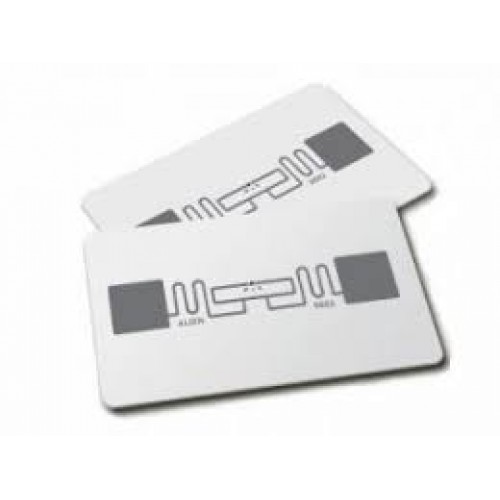
Every HF RFID and NFC product runs at 13.56 MHz. The air-interface line on the datasheet is what decides read distance, data rate and which readers and phones talk to the tag.
The proximity standard behind MIFARE cards, EMV contactless payment, e-passports and transit schemes such as Calypso. Both types run a 106 kbit/s base rate on an 847.5 kHz subcarrier; Type A uses 100% ASK with Modified Miller coding from the reader, Type B 10% ASK with NRZ-L. Current editions: Part 1:2018, Part 2:2020, Part 3:2018 and Part 4:2018.
The longer-reach HF standard. Its Part 2 abstract describes passive vicinity cards energised at up to 1 m from a coupler that stays within international RF limits. It trades speed for reach: 26.48 kbit/s from reader to tag with 1-of-4 coding. Part 2:2019 (Edition 3.0) covers the air interface; Part 3:2026, valid from 07.05.2026, the anticollision protocol.
ISO/IEC 18000-3:2010 defines three MODES at 13.56 MHz that coexist without interfering, each served by a reader that speaks it. Mode 1 is the ISO/IEC 15693 family, so library and clinical tags appear on datasheets as either “ISO 15693” or “ISO 18000-3 Mode 1”. Long-range readers commonly list Mode 1 and Mode 3.
NFC is the phone-facing profile. Type 2 runs on NFC-A; Type 3 on NFC-F (JIS X 6319-4, FeliCa); Type 4 on ISO-DEP, fully compatible with ISO/IEC 14443 over NFC-A or NFC-B; Type 5 on NFC-V (ISO/IEC 15693). NFC Forum removed Type 1 Tag features from its Technical Specification Release 2021, so new designs build on Types 2 to 5. Data rates run from 46 kbit/s to 1.7 Mbit/s.
| Interface | Coupling class | Published read distance | Data rate | Typical chips | Where it fits |
|---|---|---|---|---|---|
| ISO/IEC 14443 A/B | Proximity | Up to 100 mm for a current NFC Type 2 chip, set by field strength and antenna geometry | 106 kbit/s base; up to 848 kbit/s on current secure chips | NTAG21x, MIFARE Ultralight, MIFARE Classic EV1, MIFARE DESFire EV3 | Access cards, payment, transit and event tickets, e-passports |
| ISO/IEC 15693 (ISO/IEC 18000-3 Mode 1) | Vicinity | Up to 1 m from a coupler (standard abstract); up to 1.5 m gate width for a current label chip | 26.48 kbit/s reader-to-tag (1-of-4); 6.62 or 26.48 kbit/s tag-to-reader (ASK) | ICODE SLIX2 class | Library items, smart labels, inventory, trays and shelves |
| NFC Forum device (phone) | Near field | Typically up to 2 cm; certified compliant range 5 mm | 46 kbit/s to 1.7 Mbit/s | Type 2 (NFC-A), Type 3 (NFC-F), Type 4 (ISO-DEP), Type 5 (NFC-V) | Tap-to-open links, product authentication, smart posters, phone audits |
| Reference: UHF RAIN (ISO/IEC 18000-63) | Far field | Several metres | Built for multi-tag inventory | Gen2v2 chips (UCODE, M700 families) | Bulk counts at a distance; see UHF RFID tags |
HF read distance depends on the reader’s field strength and the geometry of both antennas, so every published figure comes with a tag size and a reader. Use these classes as sourced typical ranges and confirm them with your own tags.
NFC Forum gives a typical range of up to 2 cm and certifies compliance at 5 mm. A small hard NFC asset tag (38 × 13 × 4.5 mm) is rated up to 30 mm with a mobile phone and 40 mm with a fixed reader, measured in a laboratory. Design phone-read applications around a deliberate tap.
An embedded USB NFC module quotes approximately 25 mm per card and device. A current NFC Type 2 chip is rated at an operating distance of up to 100 mm depending on field strength and antenna geometry, and a dual-frequency card maker quotes 10 cm read/write on the HF side. That is the right scale for a counter, a kiosk or a door.
Pad-type ISO/IEC 15693 antennas read down through a stack. One tray antenna is rated up to 35–40 cm at medium reader power and 45–50 cm at high power, with reliable reads when tagged items are stacked or closely arranged. The read zone stays over the tray, where the items are.
A current ISO/IEC 15693 label chip reads without line of sight across a gate up to 1.5 m wide, with write distance equal to read distance. Long-range readers quote up to 120 cm with an ISO card-size tag at 4.5 W, and up to 2 m read/write on a 1–8 W unit. Bigger tag antennas and higher power buy the extra distance.
UHF counts many tags at several metres; HF identifies the item in front of the reader. HF earns its place wherever a short, bounded read zone, phone compatibility or card-grade cryptography matters more than distance. The UHF vs HF vs NFC guide compares the bands in full.
Library RFID has its own HF data standard: ISO 28560-1:2023 defines the data model for circulation, interlibrary loan and stock checks, and ISO 28560-2:2023 the encoding. ISO/IEC 15693 label chips carry EAS and AFI security features for the exit gate. See RFID library management.
ISO/IEC 14443 underpins EMV contactless payment. For closed-loop venues, MIFARE DESFire EV3 is specified for closed-loop payments and transport ticketing and MIFARE Ultralight for event ticketing, and wristband makers embed these chips in silicone and cloth bands. See IDPay cashless payment and RFID wristbands.
HF credentials suit a deliberate tap at a door. Where a site also wants hands-free lanes, dual-frequency cards pair an HF chip (10 cm read/write) with a UHF chip for long-range reads, so one card serves both the door reader and the vehicle or corridor lane. See access control and attendance and RFID cards.
HF tags are a good fit for bottles or vials containing liquids and keep operating on objects exposed to water, according to a 2019 labelling-industry guide; UHF is the choice for bulk counts at a distance. In a 2008 AMIA symposium study in a simulated hospital environment, 13.56 MHz tags were the most suited for identifying medications. See healthcare tracking.
Showing a tray of rings or handing over one file calls for a read zone that ends at the edge of the counter, which is what an HF pad or tray antenna gives; one vendor positions its high-power ISO/IEC 15693 reader for jewellery tracking. Whole-showroom stock counts move to UHF, as in our jewellery management system.
13.56 MHz is the same carrier everywhere. Europe allows 60 dBµA/m at 10 m for RFID and NFC in 13.553–13.567 MHz (EN 300 330 V2.1.1, 2017-02); the USA allows 15,848 µV/m at 30 m in the same band (47 CFR 15.225). UHF splits into regional bands such as 865–868 MHz and 902–928 MHz; see frequency bands by country.
HF readers range from a 4 g USB module to a wall-mounted long-range unit driving gate antennas. Read the interface and power lines first, then the supported-chip list. The reader selection guide walks through the same decision for every band.
The desk class presents itself to the PC as a smart-card reader. One embedded module conforms to PC/SC 2.0 and the CCID protocol over USB 2.0 full speed, draws up to 140 mA and reads ISO/IEC 14443 A/B at 106–848 kbit/s, ISO/IEC 15693 at 26 kbit/s, FeliCa, MIFARE and NFC Forum Types 2, 3, 4A, 4B and 5.
Wall or cabinet units drive separate antennas. Published examples: 1–5 W adjustable into one 50 Ω SMA port with Ethernet, USB and RS-232, one relay output, one opto input, IP54 and −25 to +55 °C; or 1–8 W in 250 mW steps through an internal four-output multiplexer, listed for libraries, laundries and casinos.
Datasheets list operating modes (host, scan, buffered-read, notification); match them to how your software receives reads. Look also for the transmit-power range and step, antenna ports or multiplexer outputs, host interfaces and I/O count, and radio and EMC references such as EN 300 330, 47 CFR Part 15 and EN 301 489.
Android exposes NFC-A and NFC-B (ISO/IEC 14443-3), NFC-F (JIS 6319-4), NFC-V (ISO/IEC 15693), ISO-DEP (ISO/IEC 14443-4) and NDEF as standard tag technologies. MIFARE Classic and MIFARE Ultralight access are listed as optional, present on devices that support MIFARE, so test the target handsets when a project depends on them.
Apple’s Core NFC framework reads NDEF data from NFC tags and interacts with protocol-specific ISO 7816, ISO 15693, FeliCa and MIFARE tags. For one tag that every handset reads, an NDEF record on a Type 2, 4 or 5 tag is the common denominator.
The chip, more than the tag shape, decides what an HF credential can do. These five families cover most RFQs; name the exact part, because memory and security differ inside each family.
144, 504 or 888 bytes of user memory, a factory-programmed 7-byte UID, 32-bit password protection with an optional limit on failed attempts, 10-year data retention, 100,000 write cycles and a UID mirror that serialises NDEF messages automatically. The low-cost choice for smart posters, NFC shelf labels, product authentication and phone-read wristbands.
Built for limited-use, high-volume credentials: public transport, loyalty and event ticketing. Ultralight EV1 adds a 32-bit password, Ultralight C 112-bit 3DES, and Ultralight AES 128-bit AES authentication with CMAC integrity protection (Common Criteria EAL3+).
1 kB or 4 kB, ISO/IEC 14443-3 Type A at 106 kbit/s, CRYPTO1, 4-byte NUID or 7-byte UID. MIFARE Classic’s maker points security-relevant applications to MIFARE DESFire and MIFARE Plus, so specify one of those where the credential protects value or access.
The high-security card chip: 2, 4, 8 or 16 kB, ISO/IEC 14443 A parts 1–4 with ISO/IEC 7816-4 APDUs, hardware AES-128, Common Criteria EAL5+, 106–848 kbit/s, Proximity Check against relay attacks, Secure Unique NFC (SUN) messages for phone-tap authenticity, 25-year retention and typically 1,000,000 write cycles. NFC Forum Type 4 compatible.
2,560 bits of user memory in 80 blocks of 4 bytes, EAS and AFI with password protection, an originality signature, 50-year data retention and 100,000 write cycles; reads up to 1.5 m depending on antenna geometry. The label chip for libraries, inventory and supply-chain smart labels.
The same chip ships in very different bodies. Choose the format for the surface, the handling and the service life the item will see, then confirm read distance on the real item.
Thin paper or PET labels carry the chip for books, files, shelf edges and packaging, and can be printed and encoded in one pass on an RFID printer with an HF option: one industrial series lists ISO/IEC 15693 and ISO/IEC 14443 Type A at 13.56 MHz. For the UHF equivalents, see RFID labels and inlays.
On metal, a ferrite layer is what lets an NFC sticker work; one 30 mm NTAG213 sticker is 0.5 mm thick with it. Hard NFC asset tags go further: a 38 × 13 × 4.5 mm tag works on any material, is rated IP67, withstands two hours in 10% salt water or motor oil, and fixes by adhesive, tether or cable tie.
Epoxy encapsulation suits tools, equipment and wash-down areas. One HF epoxy keyfob (30 × 45 × 1.6 mm, ISO/IEC 14443A, NFC Forum Type 4, read by NFC tap) is rated IP69K at 80 °C and 100 bar for 30 s and −40 to +85 °C operation; the family resists fuels, mineral oil and salt mist and mounts by glue, screw or encapsulation.
ISO/IEC 7810 defines the ID-1 card as 85.60 × 53.98 mm at 0.76 mm nominal; the current edition is ISO/IEC 7810:2019. The body sets lifespan: about 1 year for PVC, 3–4 years for PVC/PET composite and 5–10 years for polycarbonate, which also takes permanent laser engraving. Retransfer printing gives over-the-edge images on chip cards.
Body and closure follow wear time: disposable Tyvek with a tamper-proof adhesive closure, vinyl with a locking snap for wear over a week, reusable silicone for cashless payment and locker keys, and cloth with a locking-bead closure for anti-transfer events. Pick the chip separately: NTAG or Ultralight for tickets, DESFire for closed-loop payment.
Paste these lines into your RFQ and the quotation comes back comparable across suppliers.
Both run at 13.56 MHz. HF RFID is the wider family, defined mainly by ISO/IEC 14443 (proximity, about 10 cm) and ISO/IEC 15693 (vicinity, up to about 1 m). NFC is the phone-facing profile on top: NFC Forum devices talk to ISO/IEC 14443 A and B cards, ISO/IEC 15693 cards and JIS X 6319-4 (FeliCa) cards, with a typical range of up to 2 cm. An HF tag reads on a phone when its interface matches one of the NFC Forum tag types.
It depends on the standard, the reader power and both antennas. Published figures: about 2 cm typical for a phone, approximately 25 mm for an embedded USB module, up to 100 mm for a current NFC Type 2 chip, 35–50 cm over a tray antenna, up to 1.5 m gate width for an ISO/IEC 15693 label chip, and up to 2 m read/write on a 1–8 W long-range reader. Ask for the tag size behind each quoted figure.
Android lists NFC-A, NFC-B, NFC-F, NFC-V, ISO-DEP and NDEF as standard tag technologies, and MIFARE Classic and Ultralight as optional on devices that support MIFARE. Apple Core NFC reads NDEF data and interacts with ISO 7816, ISO 15693, FeliCa and MIFARE tags. For the widest reach, encode NDEF on a Type 2, 4 or 5 tag and test on your target handsets.
MIFARE Classic offers 1 or 4 kB of memory with CRYPTO1 security, and its maker points security-relevant applications to MIFARE DESFire and MIFARE Plus. MIFARE DESFire EV3 adds hardware AES-128, Common Criteria EAL5+ and Proximity Check against relay attacks, and is specified for access management, closed-loop payment and transport ticketing.
Choose UHF when the job is counting many items at several metres: pallets, cartons, garment rails, whole stockrooms. Choose HF when the read should be deliberate and short (a tap at a door, a till or a desk), when phones must read the tag, when card-grade cryptography is needed, or when items hold liquids. Dual-frequency cards serve sites that need both. The UHF vs HF vs NFC guide has the full comparison.
HF uses one 13.56 MHz carrier worldwide, with field-strength limits set nationally: 60 dBµA/m at 10 m for RFID and NFC under EN 300 330 V2.1.1 in Europe, and 15,848 µV/m at 30 m under 47 CFR 15.225 in the USA. Long-range reader datasheets list each approval separately (EN 300 330, FCC Part 15, IC), so name the destination market in the RFQ. See the export certification guide.
Use a tag built for metal. NFC stickers for metal add a ferrite layer (one 30 mm NTAG213 sticker is 0.5 mm thick with it), and hard NFC asset tags are rated to work on any material: one 38 × 13 × 4.5 mm tag reads up to 30 mm with a phone and 40 mm with a fixed reader. Test on the actual surface, because the mounting material affects range.
Tell us the destination country and the read point — we return the band variant, the antenna plan and a USD quotation with the conformity documents listed.