Handheld UHF · Android, Sled & Grip

Handheld UHF RFID Readers
Android Terminals, Bluetooth Sleds & Pistol Grips

A handheld UHF RFID reader puts a Gen2 radio, an antenna and a battery in the operator’s hand, so cycle counts, searches and audits happen where the stock sits. The category has three shapes: all-in-one Android terminals, Bluetooth sleds that carry a phone or mobile computer, and pistol-grip terminals built for all-shift trigger work. Five published datasheets, one per form factor, span 6–29 m nominal range, 4,000–8,000 mAh batteries and IP54 to dual IP65/IP67 sealing. This page explains what each spec line means, which figures compare across datasheets, how Android 15’s 16 KB page size affects your app, and what to put in an RFQ.
Handheld UHF RFID Readers: Android Terminals, Bluetooth Sleds & Range
Nominal read range
6–29 m
Spread across five published datasheets, entry sled to long-range sled; set by test tag and site
Battery capacity
4,000–8,000 mAh
Entry sled to Android terminal; the sled and gun-grip sheets reviewed list 7,000 mAh
Sealing
IP54–IP65/IP67
A dual-marked ultra-rugged sled has passed both the jet and the immersion test
2 We.r.p. limit for interrogators in India’s 865–868 MHz band, G.S.R. 853(E)
1.8 mConcrete drop specification on a published ultra-rugged sled datasheet
6 dBSensitivity shortfall that halves free-space read range (test-house figure)
2027From February 1, 2027, Google Play app updates must support 16 KB memory pages

Three ways to carry a UHF radio

Every handheld here reads EPC Gen2 / ISO 18000-63 tags. The differences are where the computer lives, how the device is held and how long it runs between charges, so settle the form factor before comparing range. The UHF readers overview sets handhelds beside the fixed, integrated and desktop classes.

smartphone

Android all-in-one terminal

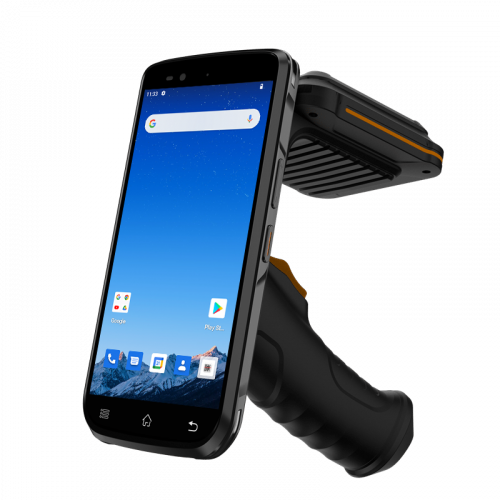
UHF module, 2D imager, display and Android share one housing, usually with a trigger handle. One current terminal datasheet lists Android 11 or 13 with GMS, an octa-core 2.3 GHz processor, 3/32 or 4/64 GB memory, an 8,000 mAh pack quoted at more than 500 h standby, 1 W (30 dBm) output with a 2 W option for markets that allow it, a circularly polarised antenna and IP65 sealing, at about 654 g with the UHF handle. One device, one charger, one management profile.

bluetooth

Bluetooth or docked sled

The sled carries radio, antenna and battery; a phone or mobile computer rides on top and supplies the screen, the OS and the network. Depending on design it snaps on through an 8-pin connector, tethers by USB-C to a phone or Windows PC, or pairs over Bluetooth. One standard-sled datasheet rates 0–30 dBm EIRP and 12 m nominal, about 541 g with its 7,000 mAh battery and batches of up to 40,000 tags. One entry-sled page lists up to 6 m on a 4,000 mAh, 3.8 V battery. A host fleet you already own is the strongest reason to choose a sled.

crosshair

Pistol-grip terminal

A trigger handle under an integrated Android computer, for operators who scan continuously. One published gun-grip datasheet lists Android 11 upgradeable to 14, a 7,000 mAh 3.6 V battery, 0 to +30 dBm RFID output, an integrated antenna across 865–928 MHz, 29 m nominal range, a mid-range or extended-range imager, IP54, multiple 1.5 m concrete drops across the operating temperature range and 1,000 tumbles at 0.5 m, at 743–769 g.

What a handheld range figure tells you

Handheld datasheets quote 6 m to 30 m for radios working under the same regional power limits. The spread comes from antenna polarisation, receiver sensitivity, the test tag and the test site, so read the footnote before the headline.

ruler

Nominal versus open-air maximum

Sled sheets give nominal figures: 12 m at 0–30 dBm EIRP and 29 m for a long-range variant at 5.5–35.5 dBm EIRP. One terminal sheet gives open-air maxima against named tags, 26, 28 and 30 m with three different inlays, measured outdoors in a low-interference environment. The same sheet adds that results are ‘affected by tags and environment’, so ask which tag and which site produced the number.

rotate-cw

Circular or linear antenna

A circularly polarised antenna reads tags in any orientation; a linear antenna concentrates its energy in one plane and reaches farther when tags line up with it. Linear units reward a deliberate sweep; circular units give steadier counts on randomly oriented stock. Confirm the polarisation in writing: one manufacturer’s web specification page and PDF sheet for the same gun-grip model list linear and circular respectively.

radio

Receiver sensitivity sets the ceiling

One reader-chip family used in current handhelds comes in four tiers rated −94, −88, −82 and −75 dBm. One test house maps about −85 dBm to 25 m, −75 dBm to 12 m and −65 dBm to under 6 m in free space, and notes that a 6 dB shortfall halves range. With transmit power capped by regulation, sensitivity separates a long-range handheld from a short one; the worked read-range calculation shows the link budget.

globe

The band is set per SKU

Handhelds ship per region: 902–928 MHz for the US, 865–868 MHz plus the 916.3, 917.5 and 918.7 MHz channels for Europe, and 916–921 MHz with listen-before-talk for Japan. India follows the ETSI lower band under G.S.R. 853(E) of 10 December 2021: 865–868 MHz, 2 W e.r.p., channels of 200 kHz or less centred on 865.7, 866.3, 866.9 and 867.5 MHz, reference standard EN 302 208. See frequency bands by country.

Shift length, sealing and drop ratings

A handheld that runs flat at hour six turns one count into two, and one that fails its first fall costs more than its price. Capacity, temperature window, IP code and drop height are the lines to compare, each with its stated test condition.

battery

Published capacities

The five example datasheets list 4,000 mAh at 3.8 V (entry sled), 7,000 mAh (standard sled, ultra-rugged sled, and gun terminal at 3.6 V) and 8,000 mAh (Android terminal, over 12 h continuous use and more than 500 h standby). The gun-terminal line also accepts its earlier 5,200 mAh pack, which keeps spares interchangeable across a fleet. Ask for run time at your RF duty cycle and for single and multi-bay cradles.

thermometer

Operating temperature

The example datasheets rate the entry sled −10 to 40 °C, the standard sled −10 to 50 °C, the gun and Android terminals −20 to 50 °C and the ultra-rugged sled −20 to 55 °C. Cold rooms, summer docks and vehicle cabs each sit near one of those limits, so state the range you actually have, including where the chargers live.

droplets

IP54, IP65 and dual IP65/IP67

Under IEC 60529 (Ed. 2.2, 2013) first digit 5 is dust-protected and 6 dust-tight; second digit 4 is splashing water, 5 a 6.3 mm nozzle at 12.5 L/min from 3 m for at least 3 minutes, and 7 immersion with the lowest point 1 m down for 30 minutes. Jet and immersion are separate tests, so the ultra-rugged sled datasheet carries both marks: ‘IP65 (spray) and IP67 (submersion)’.

arrow-down-to-line

Drop and tumble

Published drop specs are multiple 1.2 m drops to concrete (entry sled), 1.5 m (standard sled, gun and Android terminals), 1.6 m (older-generation terminal) and 1.8 m (ultra-rugged sled); the gun-terminal tumble spec lists 1,000 falls at 0.5 m. As a working map, IP54 with 1.2–1.5 m drops suits retail floors, IP65 suits yards and plants, and dual IP65/IP67 with 1.8 m suits wash-down and outdoor duty.

Barcode combos, Bluetooth profiles and Wi-Fi

Most RFID jobs still begin with a barcode: receiving against a GTIN, commissioning a tag, finding the item whose tag failed. The imager and the radios turn a reader into a complete tool.

scan-line

2D imager choice

The gun-terminal datasheet offers a mid-range imager with LED aimer or an extended-range imager decoding from 7.62 cm to 21.4 m, enough to scan a top-rack location label from the floor. The Android terminal datasheet lists standard-range, mid-range and DPM imager engines from two suppliers. Specify the furthest label and the smallest barcode you print.

link

Bluetooth profiles

The ultra-rugged sled datasheet lists SPP, HID and Apple iAP2/MFi over Bluetooth 5.3; the entry sled uses Bluetooth 5.0 with BLE. SPP carries the SDK’s full command set, HID keyboard emulation types tag data into whichever field has focus, and iAP2 serves iOS hosts. HID suits browser-based ERP clients and pilots; SPP with the SDK unlocks power control, filters and tag writes.

wifi

Wi-Fi and fleet management

The gun-terminal datasheet lists 802.11ac 2×2 MU-MIMO; the ultra-rugged sled adds Wi-Fi 6 to manage the sled itself, separately from its host. The Android terminal datasheet advertises GMS, 90-day security updates, zero-touch enrolment and FOTA, which keep a hundred devices on the same app and reader firmware. Fixed readers are managed over the network instead.

Android versions, SDKs and the 16 KB page size

A handheld stays in service for years. Its Android version, patch cadence and SDK packaging decide whether your app still installs and updates from Google Play late in that life.

smartphone

Read the OS roadmap

Current datasheets show Android 11 upgradeable to 14, or Android 11/13 with 90-day security updates; an older design still on sale lists Android 9 with Android 10 ‘coming soon’. Ask for the written upgrade path, the patch cadence and the highest API level the vendor will support across your depreciation period.

code

What a reader SDK should contain

Expect a native Android library with its .so files, a Windows library for sleds paired with tablets or PCs, and a Flutter plugin for cross-platform front ends; Identium ships SDKs for Android, Windows and Flutter. The SDK should expose power in dBm, session and target, region and channel settings, tag read, write and lock, and trigger events, with a demo app in source. Reading a reader datasheet lists the parameters.

cpu

Android 15 and 16 KB pages

Beginning with Android 15, AOSP supports devices configured with 16 KB memory pages in place of 4 KB. Google states that all apps targeting Android 15 (API level 35) and higher must support 16 KB page sizes on 64-bit devices on Google Play, and that from February 1, 2027 app updates must carry that support to be released. Apps that use NDK libraries, directly or through an SDK, need a rebuild, and reader SDKs are exactly such libraries.

list-checks

What to ask the SDK vendor

Ask for .so files built with NDK r28 or later, which compiles 16 KB-aligned by default, or with the 16 KB max-page-size linker flags on r27 and earlier, packaged with Android Gradle Plugin 8.5.1 or higher. The payoff is measurable: Google’s initial testing shows 3.16% lower average app-launch time under memory pressure and 4.56% lower power draw during launch.

Compare like with like, then write the RFQ

Five published datasheets, one per form factor, illustrate the spread. The table lists each example sheet’s figures with their conditions, so you can see which lines compare directly and which need a stated method.

circle-check

Ask for sensitivity, with the method

ISO/IEC 18046-2:2020 (published 2020-03-19) defines interrogator test methods and aims at a unified interrogator datasheet; the RAIN Alliance method (V2.0, March 2021) takes sensitivity as the weakest signal giving 90% success over at least 100 consecutive tests, with Tari, BLF and M recorded. Ask for that figure and its RF mode; it predicts range better than a metre headline.

tag

Test with your tags, in your aisle

Range curves assume a named inlay in open air, and one terminal’s maxima move from 26 m to 30 m just by changing the test tag. Bring the UHF tags or on-metal tags you will deploy and count real stock before you fix the procedure. Datasheet read rates are quoted for the fastest reader mode; one reader-chip datasheet shows the same chip moving from 1,000+ tags/s to 50+ tags/s in its most sensitive mode, so ask which mode your range and rate figures share.

layout-grid

Where handhelds fit

Handhelds carry cycle counts, search and exception handling in inventory, asset, apparel retail and tool tracking systems. Dock doors go to fixed readers, lanes to integrated readers and encoding desks to desktop readers; a warehouse system often uses all four. The reader selection guide walks through the split.

shopping-cart

Buy or specify

Stock handheld configurations are listed at India RFID Store. For USD export quotes on EXW, FOB, CIF or DDP terms, or an OEM/ODM build around your housing or software, send the checklist below. FCC-band and ETSI-band variants are configured per order, and the export certification guide lists what each market asks for. The full range sits under RFID hardware.

One example datasheet per form factor (vendor figures under vendor test conditions; a dash marks a line the sheet leaves blank)
Spec lineAndroid terminal (example sheet)Pistol-grip terminal (example sheet)Standard sled (example sheet)Ultra-rugged sled (example sheet)Entry sled (example sheet)
RF output1 W (30 dBm); 2 W option where allowed0 to +30 dBm0–30 dBm EIRP0–30 dBm EIRP; long-range 5.5–35.5 dBm EIRP (US)—
Read range26–30 m open-air maximum, by tag29 m nominal12 m nominal12 m / 29 m nominalUp to 6 m
Fastest read rate (vendor)1,300+ tags/s900+ tags/s1,300+ tags/s1,300+ tags/s—
Battery8,000 mAh7,000 mAh, 3.6 V7,000 mAh7,000 mAh4,000 mAh, 3.8 V
SealingIP65IP54IP54IP65 (spray) and IP67 (submersion)IP54
Drop to concreteMultiple 1.5 mMultiple 1.5 mMultiple 1.5 mMultiple 1.8 mMultiple 1.2 m
Operating temperature−20 to 50 °C−20 to 50 °C−10 to 50 °C−20 to 55 °C−10 to 40 °C
Host or OSAndroid 11/13, GMSAndroid 11, upgradeable to 148-pin connector or USB-CBluetooth 5.3 (SPP, HID, iAP2); Wi-Fi 6Bluetooth 5.0 and BLE
Weight654 g with UHF handle743–769 gAbout 541 g714–799 g—

What to Put in the Enquiry

Paste these lines into your RFQ and the quotation comes back comparable across suppliers.

  1. Form factor: Android all-in-one terminal / Bluetooth sled for host model [x] / pistol-grip terminal; quantity [n].
  2. Region and band: ETSI lower band 865–868 MHz (India, EU) or FCC 902–928 MHz; destination country [x].
  3. RF output adjustable in dBm (state range, e.g. 0–30 dBm); antenna polarisation (circular or linear); nominal read range with the test tag and conditions named.
  4. Receive sensitivity in dBm with method (ISO/IEC 18046-2:2020 or RAIN Alliance V2.0, 90% success over 100 tests) and the RF mode used; read rate stated for the same RF mode.
  5. Battery: capacity in mAh and voltage, replaceable pack, run time at [x]% RF duty cycle, single and multi-bay cradles.
  6. Ruggedness: IP code per IEC 60529 (dual IP65/IP67 for wash-down), drop height and count to concrete, tumble spec, operating and charging temperature.
  7. Imager: 2D engine class (standard, mid or extended range, DPM), maximum decode distance, smallest code to read.
  8. OS: Android version at ship, written upgrade path, security-patch cadence, GMS, zero-touch enrolment and FOTA.
  9. SDK: Android library with 16 KB-aligned .so files (NDK r28+ or 16 KB linker flags, AGP 8.5.1+), Windows library, Flutter plugin, demo app source; Bluetooth SPP, HID and iAP2 profiles.
  10. Compliance and terms: radio test reports for the destination (FCC Part 15, EN 302 208, India type approval); HS code; USD price on EXW/FOB/CIF/DDP.

Handheld UHF RFID Readers, Answered

How far can a handheld UHF RFID reader read?

In the five example datasheets, nominal figures run from about 6 m for an entry sled to 12 m for a standard sled and 29 m for a long-range sled and a gun terminal; one terminal datasheet adds open-air maxima of 26–30 m with the test tag named. Indoors on real stock the working figure depends on receiver sensitivity, tag orientation, the material behind the tag and reflections, and a 6 dB loss halves free-space range. Name your tag and test in your own aisle before fixing the count procedure.

Should I choose a Bluetooth sled or an all-in-one Android terminal?

Choose a sled when you already run phones or mobile computers, need iOS, or want radio and computer replaced on separate cycles; depending on design it attaches by an 8-pin connector, USB-C or Bluetooth, and one standard-sled datasheet batches up to 40,000 tags. Choose a terminal for one device, one charger and one management policy, with a trigger handle for all-shift scanning. The sled datasheets reviewed list about 541–799 g before the host goes on; the complete terminals list 654–769 g.

Which band variant should I order for India?

India’s licence-exempt RFID rules are G.S.R. 853(E) of 10 December 2021: 865–868 MHz, interrogators up to 2 W e.r.p., channel bandwidth of 200 kHz or less on the four channels centred at 865.7, 866.3, 866.9 and 867.5 MHz, reference standard EN 302 208. That mirrors the ETSI lower band, so specify the ETSI-band variant. Handhelds are configured per region, with US (902–928 MHz) and Japan (916–921 MHz) variants alongside.

What is the difference between IP54, IP65 and a dual IP65/IP67 marking?

Under IEC 60529 the first digit covers solids (5 dust-protected, 6 dust-tight) and the second covers water (4 splashing, 5 a 6.3 mm jet from 3 m, 7 immersion at 1 m for 30 minutes). Jet and immersion are separate tests, so a dual IP65/IP67 marking records both. Wash-down and outdoor sites should ask for the dual marking; retail floors are well served by IP54.

Will my Android RFID app keep working on new handhelds?

Check the SDK’s native libraries. Android 15 added support for 16 KB memory pages, and Google requires apps targeting Android 15 (API level 35) or higher to support 16 KB pages on 64-bit devices on Google Play, with updates needing that support from February 1, 2027. Ask the reader vendor for .so files built with NDK r28 or later, or with the 16 KB linker flags, packaged with AGP 8.5.1 or newer.

Do I need the vendor’s SDK, or can the reader type EPCs?

Both routes work. In Bluetooth HID mode a sled acts as a keyboard and types tag data into the focused field, which suits browser-based ERP clients and pilots. The SDK route over SPP or USB gives your app power control in dBm, session and filter settings, tag read, write and lock, and trigger events; it is the route for production apps, and Identium’s SDKs cover Android, Windows and Flutter.

What radio approvals should an RFQ ask for?

Name the destination market and ask for the test report: FCC Part 15 for the United States and the harmonised standard EN 302 208 for Europe, while India’s 2021 rules call for equipment type approval. Identium’s UHF readers are BIS and WPC approved for India’s licence-free UHF band, and FCC-band and ETSI-band variants are configured per order. The export certification guide lists each authority’s documents.

Specify it once, quote it anywhere.

Tell us the destination country and the read point — we return the band variant, the antenna plan and a USD quotation with the conformity documents listed.