Put a standard UHF inlay on steel and the metal reflects the signal and detunes the antenna. On-metal tags solve that with a spacer or ferrite layer, a circuit-board or ceramic body, or a welded steel shell, and are tuned to read with metal behind them. This page explains each construction, the read-range classes vendors publish — about 1 m for embedded micro tags up to 20 m for heavy-industry hard tags — the mounting methods from adhesive to welding, and the temperature, sealing and memory lines to put in an RFQ.
A standard UHF label is a thin dipole tuned for cardboard, plastic or open air. Metal changes how that antenna behaves, and on-metal tags are designed around the change.
A metal surface reflects RF energy and shifts the tag antenna’s tuning, so an ordinary dipole label on steel turns short-range or falls silent. Printer makers apply the same rule to media: foil- or metal-backed stock belongs with tags designed for it. Paper, plastic and corrugate jobs stay on standard labels and inlays.
On-metal designs insert a non-conductive layer — foam, plastic or ferrite — between the antenna and the surface, often add a ferrite layer that absorbs and redirects the field, use an antenna tuned for a metal backing, and encase the stack in hard plastic or rubber.
Because the design expects metal behind it, on-metal figures run higher than off-metal ones: one plate tag is rated 10 m on metal and 7 m on plastic, a flag tag 18 m against 7 m, and a cylinder-neck tag publishes its range for metal alone. List every surface the tag will sit on.
One compact-tag datasheet notes the tag performs best on a large, even metal surface with metal contact under the whole tag. Curved shells, narrow flanges and recesses change the result, so ask for test data on the real mounting spot before committing volume.
Construction sets thickness, ruggedness and range. These four families cover most of what buyers meet, from 0.9 mm printable labels to cased tags 15 mm deep.
Thin labels with a special backing for metal. Sourced examples are white PET, 0.9–1.2 mm thick and self-adhesive, reading 2.5–4.5 m on metal at 2 W ERP depending on size, sealed to IP68 (1 m × 24 h) and rated −20 to +70 °C. They encode and print in label printers with resin ribbon. Among industrial RFID printer-encoders, one takes on-metal tags up to 1.2 mm thick through an external RFID antenna; another offers a field-installable on-metal kit for 203 and 300 dpi printheads.
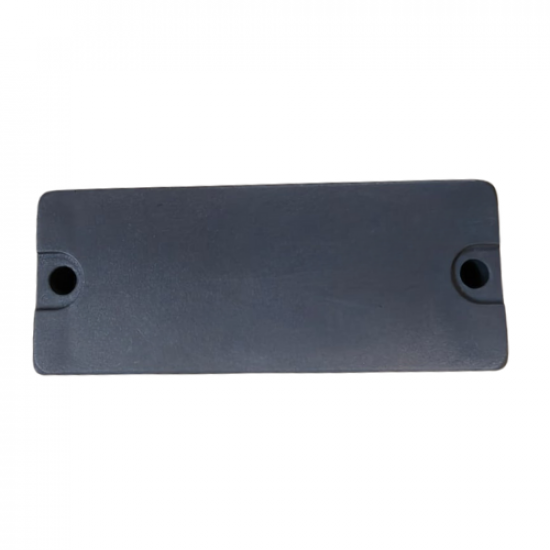
Spacer and antenna sealed in a PC/ABS, thermoplastic or metal-faced case. An aluminium-faced, stainless-backed 108 × 51 × 3.7 mm plate is rated up to 10 m on metal; a 139 × 53 × 15 mm, 52 g heavy-industry tag up to 20 m with a fixed reader, tested to MIL-STD-810G shock and vibration and to impacts above 25 kg from 1 m.
Built on FR4 circuit-board material, in sizes down to 12 mm long. Published examples: 12 × 4 × 1.5 mm and 0.2 g, reading 1.5 m on metal with a fixed reader and 0.6 m handheld; 22 × 8 × 3.0 mm with two 2 mm screw holes, reading 4.5–4.7 m fixed and 2.6–3.0 m handheld. Both are IP68 and −40 to +100 °C, with separate US and EU order codes.
For the smallest parts, a 13.1 × 7.1 × 3.1 mm ceramic micro tag reads up to 4 m fixed and 2 m handheld, and its high-temperature version is rated for exposure to 225 °C. Embeddable ‘dot’ (6 mm diameter × 2.5 mm) and ‘dash’ (12.3 × 3 × 2.2 mm) tags read 1.5–2.0 m on metal and 1.0–1.5 m set into it, with 1176 kPa compression strength.
Datasheet ranges are vendor values, usually theoretical at 2 W ERP or measured with a fixed reader in a clean environment. Use them as classes for shortlisting, then confirm on the real asset.
Theoretical range curves are calculated from measured tag sensitivity at 35 dBm EIRP, which equals 33 dBm ERP or 2 W ERP — the ETSI lower-band ceiling, and India’s limit under G.S.R. 853(E). Under the FCC 4 W EIRP limit, add about 11%. The read-range worked example and the ERP and EIRP power budget show the arithmetic.
Datasheets quote the two reader types separately, and the gap is wide: 20 m fixed against 9 m handheld for one heavy-industry tag, 4 m against 2 m for a ceramic micro tag, 1.5 m against 0.6 m for the smallest PCB tag. Ask for both when the plan mixes handheld audits with fixed portals.
Tags are tuned for ETSI 865–868 MHz (Europe, and India, which mirrors the ETSI lower band), FCC 902–928 MHz, or both. A 27 mm square tag tuned globally reads up to 5 m in the EU band and 4 m in the US band; its region-specific versions reach 7 m and 6.5 m. Match tuning to the destination with frequency bands by country.
Across the datasheets above, range tracks tag size: a 6 mm dot gives about 1.5 m on metal, a 22 mm PCB tag about 4.5 m, a 108 mm plate 10 m and a 139 mm heavy-industry tag 20 m. Where the mounting spot has room, a larger tag is the direct way to gain range.
| Class | Example size | Range on metal (vendor figure) | Attachment | Sealing and temperature |
|---|---|---|---|---|
| Embeddable micro | 6 mm dia. × 2.5 mm; 12.3 × 3 × 2.2 mm | 1.5–2.0 m; 1.0–1.5 m embedded | Epoxy or set into metal | IP68; −30 to +85 °C |
| Ceramic micro | 13.1 × 7.1 × 3.1 mm | 4 m fixed / 2 m handheld | Film or liquid adhesive; recess | IP68; high-temperature version to 225 °C exposure |
| PCB (FR4) | 12 × 4 × 1.5 to 22 × 8 × 3.0 mm | 1.5–4.7 m fixed / 0.6–3.0 m handheld | Adhesive; screw holes on larger sizes | IP68; −40 to +100 °C |
| Printable on-metal label | 60 × 24 × 1.2 to 107 × 19 × 0.9 mm | 2.5–4.5 m at 2 W ERP | Self-adhesive PET | IP68 (1 m × 24 h); −20 to +70 °C |
| Cylinder-neck tag | 34 × 8.9 mm | Up to 4.5 m (902–928 MHz) | High-performance adhesive | IP68 |
| Weld-on steel shell | 44.5 × 3.0 or 44.5 × 11.4 mm | Up to 3.0 m at 36 dBm EIRP | Stainless ring shell welded to the asset | −40 to +200 °C |
| Compact square hard tag | 27 × 27 × 5.5 mm | 4–5 m global-tuned; 6.5–7 m region-tuned | Acrylic adhesive | IP68; −35 to +85 °C |
| Plate hard tag | 108 × 51 × 3.7 mm | Up to 10 m at 2 W ERP | M3 screw or foam adhesive tape | IP68 (5 h at 1 m); −35 to +85 °C, +130 °C for 10 min |
| High-temperature hard tag | 86 × 26 × 8.5 mm | Up to 10 m at 2 W ERP | Polyurethane structural adhesive or mechanical | IP68; peaks to 235 °C |
| Flag / heavy-industry | 52 × 29 × 14 to 139 × 53 × 15 mm | 18 m theoretical at 2 W ERP; 20 m fixed / 9 m handheld | Single screw; 6.5 mm hole with slot | IP68 to IP69K; −40 to +85 °C |
The fixing method decides whether the tag stays with the asset for its working life. Datasheets recommend mechanical fixing for the harshest environments and wherever there is a risk of mechanical stress or a low temperature during fixing.
Foam tapes and high-performance acrylic adhesives suit clean, even surfaces. Apply on a clean, dry surface, ideally at +21 to +38 °C and above 10 °C. Ceramic micro tags are designed around a 130 µm (±20%) adhesive film; the datasheet ties optimal RF performance to that bond-line thickness.
Hard tags carry fixing points: an M3 hole on a plate tag, a 6.5 mm hole with a 3.2 × 24 mm slot on a heavy-industry tag, a single screw on a flag tag, and 2–3 mm holes on larger PCB tags. Rivet-mount tags give permanent attachment. Makers recommend mechanical fixing for the harshest environments and any risk of mechanical stress.
Tools and machined parts take micro tags in a pocket: one datasheet specifies a 26 mm × 5.5 mm deep recess with a carrier, others use epoxy. In one embeddable series, range drops by about 0.5 m once the tag sits inside metal — 1.0–1.5 m embedded against 1.5–2.0 m surface-mounted — so ask for embedded figures for the tag you shortlist.
For permanent steel assets, a ceramic-encapsulated tag in a stainless-steel ring shell is welded to the surface; one such tag is rated up to 3.0 m under FCC Part 15 at 36 dBm EIRP and −40 to +200 °C. High-temperature hard tags use polyurethane structural adhesives or mechanical fixing instead.
After range and mounting, these spec lines decide how long a tag serves the asset. Ask for each as a stated test, with conditions.
Ask for each separately. Continuous operating range: −35 or −40 to +85 °C on hard tags, −20 to +70 °C on PET labels, −40 to +100 °C on PCB tags. Short peak: +130 °C or +140 °C for 10 min. Process profile: 235 °C over 50 × 5 h cycles, 220 °C over 150 × 2 h, and autoclave at 125 °C / 0.141 MPa / 30 min on a high-temperature tag.
IEC 60529 (edition 2.2, 2013-08-29) leaves IPX8 immersion depth and duration to the manufacturer, so ask for them: on-metal datasheets quote 1 m × 24 h and 5 h at 1 m. For washdown, IP69K covers high-pressure, high-temperature jets (80 °C, 80–100 bar), and one long-range flag tag carries it.
Chemical resistance is quoted as soak tests: 168 h in 10% sodium hydroxide and 168 h in 10% sulphuric acid on a flag tag; 168 h in motor oil and in 10% salt water on a compact tag; plus UV and sea-water resistance. List the fluids your site uses and ask for matching results.
Heavy-industry tags quote MIL-STD-810G shock and vibration and drop-weight impact: above 25 kg from 1 m, with 15 kg as the limit that keeps IP68. Embeddable micro tags quote compression strength instead — 1176 kPa on one dot and dash series.
On-metal tags use chips with user memory: one flag tag carries Impinj M780 (496-bit EPC, 128-bit user); chip options include Impinj M781 (128-bit EPC, 512-bit user) and NXP UCODE 9xm (752, 624 or 384 user bits depending on EPC length). Industrial chips are rated 100,000 write cycles and 20-year retention; ceramic and PCB tag datasheets quote up to 50 years. See the Gen2 memory bank guide.
Each asset group below has a construction that fits its surface, size and handling. Start from the asset, then pick the tag family.
Hand tools, torque wrenches and gauges take embeddable or ceramic micro tags set into a recess or bonded with epoxy, readable at about 1.0–1.5 m embedded — close enough for crib check-in and handheld audits in tool tracking.
Servers, racks, laptops and enclosures suit printable on-metal labels: the same PET face carries the asset number and barcode while the chip reads at 2.5–4.5 m, which supports walk-through audits in asset management.
Purpose-shaped tags fit the cylinder: one neck-fit design is 34 × 8.9 mm, adhesive-bonded, IP68 and rated up to 4.5 m on metal in the 902–928 MHz band. Datasheet ranges assume an even surface, so request curved-surface test data for shoulders and collars. See crate and cylinder tracking.
Long-range flag and heavy-industry tags, at 18 m (theoretical, 2 W ERP) to 20 m with a fixed reader, give dock-door portals a wide margin on steel pallets and roll cages; screw or rivet fixing follows the datasheet advice for mechanical stress. Pair them with portal antennas and pallet tracking.
Jigs, carriers and parts that pass through heat use high-temperature hard tags rated for repeated 235 °C peaks and autoclave cycles, so the ID follows the item station by station in WIP tracking. For non-metal items, compare the wider UHF tag range.
Paste these lines into your RFQ and the quotation comes back comparable across suppliers.
Metal reflects RF and detunes a standard dipole label, which makes it short-range or silent on steel. Use an on-metal construction instead: a 0.9–1.2 mm printable on-metal PET label (2.5–4.5 m on metal at 2 W ERP in sourced examples) or a spacer-built hard tag. Standard labels and inlays remain the right choice for cartons, plastics and textiles.
On-metal tags are tuned for a metal backing, so their off-metal figures run lower: one plate tag is rated 10 m on metal and 7 m on plastic, a flag tag 18 m on metal and 7 m on plastic. If the same tag must work on both, list both surfaces in the RFQ and ask for both figures.
Vendor figures on metal run from about 1.0–1.5 m for micro tags set into metal, through 2.5–4.5 m for printable labels and 4–7 m for compact hard tags, to 10 m for plate tags, 18 m (theoretical, 2 W ERP) for a long-range flag tag and 20 m with a fixed reader for a heavy-industry tag. They are theoretical or clean-environment values, and handheld figures run lower (9 m against 20 m on one tag). Write the target into a tender with the specification template; stock formats are listed in the online store’s on-metal category.
For adhesive, two hard-tag datasheets advise clean, even surfaces and application at +21 to +38 °C, and above 10 °C. Datasheets recommend mechanical fixing — M3 screws, slotted holes, single-screw flags or rivets — for the harshest environments and wherever there is a risk of mechanical stress or a low temperature during fixing. Weld-on steel shells suit permanent steel assets, and recesses or epoxy suit tools.
Printable on-metal PET labels, 0.9–1.2 mm thick, encode and print in label printers with resin ribbon. One industrial printer-encoder takes on-metal tags up to 1.2 mm thick through an external RFID antenna; another offers a field-installable on-metal kit for 203 and 300 dpi printheads. Thicker hard tags are encoded with a desktop or handheld reader; see RFID printers.
Order the tuning of the country where the tags will be read: ETSI 865–868 MHz for Europe and India (India permits 2 W e.r.p. in 865–868 MHz under G.S.R. 853(E) of 10 December 2021), FCC 902–928 MHz for North America, or a global tuning for mixed fleets. Region-specific tuning reads further: one compact tag gives 5 m (EU) and 4 m (US) in its global version against 7 m and 6.5 m in its region-specific versions.
On-metal datasheets list configurations such as 128-bit EPC only, 496-bit EPC with 128-bit user memory on a flag tag, and 448-bit EPC with 2048-bit user memory on a high-temperature tag. Chip options extend this: Impinj M781 offers 128-bit EPC with 512-bit user memory, and NXP UCODE 9xm offers 752, 624 or 384 user bits. Industrial chips are rated 100,000 write cycles with 20-year retention, and some ceramic and PCB tags quote up to 50 years.
Tell us the destination country and the read point — we return the band variant, the antenna plan and a USD quotation with the conformity documents listed.