Fixed · Handheld · Desktop · Integrated

UHF RFID Readers:
Four Form Factors, Compared Line by Line

A UHF RFID reader powers passive tags with its radio field and decodes their backscattered replies. Fixed, handheld, desktop and integrated readers all speak the same EPC Gen2v2 / ISO/IEC 18000-63 air interface; they differ in where the antenna sits, how the reader is powered and what it plugs into. This hub compares the four form factors line by line — ports, transmit power, receive sensitivity, interfaces and enclosure — explains the band variant each destination market needs, and closes with RFQ lines ready to paste into a tender. Every figure is a sourced typical range from published datasheets and standards.
UHF RFID Readers: Fixed, Handheld, Desktop & Integrated Compared
Fixed reader ports
2, 4 or 8
Monostatic RP-TNC or SMA ports; four 8-output hubs take a 4-port reader to 32 read zones (reader datasheets; hub brief, 2017)
Handheld nominal range
6–29 m
From an entry Bluetooth sled to long-range gun-grip and sled classes (vendor nominal figures)
Integrated antenna
8–8.5 dBic
Circular patch with a 65–80° beam; one flat-panel class is rated 5 m at +30 dBm ERP and 7 m at +33 dBm ERP
2 We.r.p. ceiling per interrogator channel in the 865–868 MHz band (EN 302 208; G.S.R. 853(E), 2021)
1 WFCC peak conducted limit for 902–928 MHz readers, with antenna gain up to 6 dBi (47 CFR 15.247)
32antenna ports from one 4-port fixed reader fitted with four 8-output hubs
90%success rate over at least 100 tests that defines receive sensitivity (ISO/IEC 18046-2 method)

Four reader form factors on one air interface

All four talk to the same passive tags over EPC Gen2v2 / ISO/IEC 18000-63; antenna arrangement, power source and host link set them apart. The table gives sourced typical ranges, and each card links to its sub-page.

server

Fixed readers: one box, many read points

A fixed reader feeds two, four or eight external antennas, so one unit covers a dock-door portal or several conveyor points. Current enterprise units run 10–33 dBm conducted with −93 dBm typical receive sensitivity. Ports, PoE limits and GPIO are covered on fixed UHF RFID readers.

smartphone

Handheld readers: take the reader to the stock

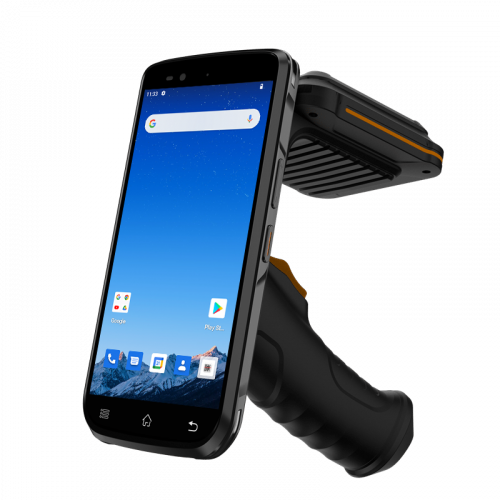
Android gun-grip computers with the RFID engine built in, or Bluetooth sleds that clip to a phone. Nominal ranges run from 6 m on entry sleds to 29 m on long-range units. Compare classes on handheld UHF RFID readers.

monitor

Desktop readers: the tag comes to the operator

USB readers for encoding, enrolment and counter work, from 0–9 dBm encoders to 1 W-class units with an external antenna port. Some present as a USB keyboard, typing the EPC into any form. See desktop UHF RFID readers.

box

Integrated readers: reader and antenna in one housing

A sealed unit with a built-in 8–8.5 dBic circular antenna and one to three extra ports. Gate-and-lane units add RS-485 and Wiegand; PLC-oriented units speak PROFINET, EtherNet/IP and OPC UA on 24 V DC. Details on integrated UHF RFID readers.

Spec lineFixedHandheldDesktopIntegrated
Antenna2, 4 or 8 external monostatic ports (RP-TNC or SMA); 32 read zones via hubsBuilt-in, linear or circular polarisedInternal antenna; external RP-SMA port on 1 W-class unitsBuilt-in 8–8.5 dBic circular patch, 65–80° beam, plus 1–3 external ports
Transmit power10–33 dBm conducted; 30 dBm ceiling on 802.3af PoE0–30 dBm (EIRP on standard sleds); long-range sleds to 35.5 dBm EIRP0–9 dBm on encoders; adjustable to 30 dBm (1 W) on USB long-range unitsUp to 33 dBm conducted; 33 dBm ERP (ETSI) / 36 dBm EIRP (FCC) radiated
Host interfaces10/100 or gigabit Ethernet with LLRP, USB host and device, DB9 serial; 2 in / 3 out to 4 in / 4 out GPIOBluetooth 5.0–5.3 (SPP and HID profiles); Wi-Fi on gun-grips and rugged sledsUSB as virtual COM port or HID keyboardEthernet, RS-232, RS-485, Wiegand; PROFINET, EtherNet/IP and OPC UA on industrial units
PowerPoE (802.3af), PoE+ (802.3at) or 12–48 V DCLi-ion pack, 4,000–8,000 mAhUSB bus power; 6.2 W max on 1 W-class unitsPoE+ (802.3at), 9–30 V DC or 24 V DC
Nominal read rangeSet by the external antennas, cable loss and tags6–29 m (vendor nominal, by class)10–80 cm on encoders; 1.2 m internal, up to 10 m with an external antenna1.5 m (low-gain) to 15 m (gate and lane units)
EnclosureIP50–IP53 indoor; IP67 with M12 connectors for outdoorIP54–IP65; IP65/IP67 dual-rated ultra-rugged; 1.2–1.8 m dropsIndoor desk and counter useIP65–IP67 for lanes and gates; IP20 for indoor flat panels
Typical useDock doors, portals, conveyors, smart shelvesCycle counts, receiving checks, search and locateTag encoding, issue and return counters, point of saleVehicle lanes, gates, access control, machine stations

The datasheet lines that separate one reader from another

Five lines carry most of the performance story, each meaningful with its test condition attached. Our guide to reading a UHF reader datasheet walks through a full sheet; the short version is below.

zap

Transmit power: conducted versus radiated

Datasheets quote conducted power at the port; regulators cap radiated power, as e.r.p. in Europe and India and EIRP in the US. A half-wave dipole has 2.15 dB gain over isotropic, so 2 W e.r.p. ≈ 3.28 W EIRP. The arithmetic is worked in our ERP and EIRP power-budget guide.

ear

Receive sensitivity, with its method

Sensitivity is the weakest tag reply the receiver decodes: under ISO/IEC 18046-2, the smallest signal at which the reader passes 90% of at least 100 consecutive tests. One fixed reader publishes −94 dBm ideal, −93 dBm typical and −88 dBm at a challenging 12 dB return loss.

gauge

Read rate, with its RF mode

Headline rates of 900 to 1,300+ tags per second are fastest-mode figures. One vendor’s 1,100 reads per second applies to reader mode 0 in an FCC-like region; a reader-chip table lists its most sensitive mode at 50+ tags per second. Request rate and sensitivity in the same mode.

git-branch

Antenna ports and multiplexing

Monostatic ports transmit and receive on one connector. Hubs add eight outputs each; 8- or 16-port multiplexers cascade to 256 or 1,024 antennas. Each switching stage adds about 1.2–1.4 dB insertion loss, which belongs in the link budget.

cpu

Reader-chip tier and firmware path

Compact readers use reader ICs sold in sensitivity tiers; one family spans −94, −88, −82 and −75 dBm at chip level. A RAIN Alliance announcement of January 2025 reports that Gen2v3 passed a first membership ballot as a backward-compatible update; reader makers need only a software update.

Band variants: each reader is configured for its destination

National rules split the 860–960 MHz range, so a reader is specified for its country of installation. Identium configures FCC-band (902–928 MHz) and ETSI-band (865–868 MHz) variants per order; the bands-by-country guide covers other markets.

flag

Europe and India: 865–868 MHz

ETSI EN 302 208 V3.4.1 (2023-12) gives interrogators four 200 kHz channels centred at 865.7, 866.3, 866.9 and 867.5 MHz, at up to 2 W e.r.p. (33 dBm). India’s G.S.R. 853(E) of 10 December 2021 sets 865–868 MHz at 2 W e.r.p. on the same four channels, names EN 302 208 as reference standard, and caps continuous transmission on a channel at 4 s.

layers

Europe upper band: 915–921 MHz

The same standard adds 400 kHz channels at 916.3, 917.5 and 918.7 MHz (plus 919.9 MHz in some countries) at up to 4 W e.r.p. (36 dBm); EU member states are asked to implement three channels.

globe

Americas: 902–928 MHz

Under 47 CFR 15.247 a hopping reader with channels under 250 kHz uses at least 50 of them, dwelling 0.4 s or less on each in any 20 s. Peak conducted output is 1 W, reduced dB for dB above 6 dBi antenna gain: 30 dBm + 6 dBi = 36 dBm, or 4 W EIRP.

radar

Antenna beam-width sets the usable power

In the 865–868 MHz band EN 302 208 ties e.r.p. to beam-width: above 500 mW to 1 W needs 180° or less, above 1 W to 2 W needs 90° or less. A 100° wide-beam patch runs at up to 1 W e.r.p. Options are on RFID antennas.

map

Other national plans

Country channel masks cover sub-bands such as China 920.125–924.875 MHz, Australia 920–926 MHz and Japan 916.8–920.8 MHz. Some vendors ship separate Global, ETSI and Japan hardware SKUs, so the RFQ should name the country.

Power, host interfaces and I/O

How a reader is powered and wired drives installation cost as much as RF does.

battery-charging

PoE versus PoE+

IEEE 802.3af delivers about 13 W at the device; 802.3at (PoE+) delivers 25.5 W. On one enterprise reader that is the difference between a 30 dBm and a 33 dBm transmit ceiling. Outdoor industrial units specify a 30 W switch port, Cat 6 and runs of 100 m or less.

network

Ethernet and host protocols

Fixed readers expose 10/100 or gigabit Ethernet with LLRP as the common host protocol. Embedded-Linux readers add HTTP, MQTT, SQL and TCP outputs and USB keyboard emulation, sending tag data straight to a web service, database or form field.

cable

RS-232 and RS-485

RS-232 is point-to-point and typically reaches about 15 m at 19,200 baud. RS-485 is a differential multidrop bus for 32 devices, reaching 1,200 m at low baud rates and roughly a third of that at 115.2 kbps, on 120 Ω terminated twisted pair.

key

Wiegand for access controllers

The 26-bit frame carries two parity bits, an 8-bit facility code and a 16-bit ID, one way from reader to controller, over about 90 m of 24 AWG or 150 m of 18 AWG. This is how a UHF reader joins an existing access control and attendance system.

toggle-right

GPIO for triggers and signals

Opto-isolated inputs accept 0–30 V (logic 1 at 3–30 V); industrial outputs switch up to 30 V at 500 mA. Counts run from 2 in / 3 out to 4 in / 4 out. Inputs take photo-eyes or motion sensors that start a read; outputs drive lights, buzzers or barrier relays.

How to choose: start from the read event

Ask where the tag is when it must be read, then let the environment pick the enclosure. Our reader selection guide expands each step.

truck

Items move past a fixed point

Dock doors, conveyors and portals call for a fixed reader. Common portal practice puts two to four antennas on each side of the door, with photo-eyes gating the read and time-slotting between adjacent doors. This is the core of an RFID warehouse management system.

scan

People walk to the items

Cycle counts and search tasks suit a handheld. Compare range class, battery, drop rating and Android upgrade path; one current gun-grip ships on Android 11, upgradeable to Android 14. Handhelds do the counting in RFID inventory management.

keyboard

Items come to the operator

Encoding, issue counters and point of sale suit a desktop reader; 0–9 dBm output keeps the zone to 10–80 cm, and a near-field antenna confines it to 7.5 cm. For labels in volume, a printer-encoder prints and encodes in one pass — see RFID printers.

car

One lane, one zone

Vehicle lanes and machine stations suit an integrated reader: one cable run, a fixed 8–8.5 dBic beam and Wiegand or RS-485 into the controller. Credentials are on UHF RFID tags and RFID cards; the full lane design is in RFID vehicle parking management.

droplets

Environment sets the enclosure

Under IEC 60529, first digit 6 is dust-tight; second digit 5 is 6.3 mm nozzle jets, 6 powerful jets, 7 immersion to 1 m for 30 minutes. Water ratings above IPX6 stand alone, so specify dual marking such as IP65/IP67 for hose-down plus immersion.

target

Sensitivity class and range

One test house groups readers at about −85, −75 and −65 dBm (portal, regular fixed, budget), roughly 25 m, 12 m and under 6 m in free space; a 6 dB swing halves range. Test with the real tagged items.

Specifying and sourcing UHF readers

A reader RFQ works best when every performance line carries its measurement condition. Our UHF tender specification template has paste-ready wording.

file-text

Ask for comparable numbers

ISO/IEC 18046-2:2020 (Edition 2.0, 2020-03-19) defines interrogator test methods and a unified interrogator datasheet. Citing it, with RF mode and region, lets bids be compared line for line.

wrench

Designed and built in-house

Identium designs and builds its UHF reader hardware and software in-house in New Delhi, with SDKs for Android, Windows and Flutter and OEM/ODM builds. Quotes are in US dollars on EXW, FOB, CIF or DDP terms. Details on RFID manufacturer and exporter.

shield

India approvals in hand

Identium’s UHF readers are BIS and WPC approved for India’s licence-free UHF band, so installations in India start with the paperwork ready.

shopping-cart

Stock units online

Standard readers are listed on our online shop, indiarfidstore.com. For the rest of the range, browse RFID hardware.

What to Put in the Enquiry

Paste these lines into your RFQ and the quotation comes back comparable across suppliers.

  1. Form factor and quantity: fixed (2, 4 or 8 ports), handheld (gun-grip or sled), desktop or integrated; number of read points per site.
  2. Country of installation and band variant: 865–868 MHz (ETSI / India, four 200 kHz channels at up to 2 W e.r.p.) or 902–928 MHz (FCC 47 CFR 15.247), or the named national plan.
  3. Air interface: EPC Gen2v2 / ISO/IEC 18000-63, with the firmware path for Gen2v3 stated.
  4. Transmit power: conducted range in dBm, step size and accuracy, and the ceiling on PoE (802.3af) versus PoE+ (802.3at) or DC.
  5. Receive sensitivity in dBm measured per ISO/IEC 18046-2:2020, with RF mode and return-loss condition stated.
  6. Read rate in tags per second, stated for the same RF mode and region as the sensitivity figure.
  7. Antenna ports: count, connector (RP-TNC or SMA), hub or multiplexer support and maximum antennas per reader.
  8. Host interfaces: Ethernet with LLRP, USB, RS-232 / RS-485, Wiegand 26-bit, Bluetooth or Wi-Fi; GPIO count and input voltage range.
  9. Environment: IP code per IEC 60529 (both digits; dual marking if jets and immersion apply), operating temperature, drop height for handhelds.
  10. Software: SDK for Android, Windows or Flutter; Android version shipped and supported upgrade path for handhelds.

UHF RFID Readers, Answered

What is the difference between a fixed and an integrated UHF reader?

A fixed reader is a box with two, four or eight antenna ports: you choose, mount and cable the antennas, so one reader covers several read points or a multi-antenna dock-door portal. An integrated reader builds an 8–8.5 dBic circular antenna into the housing and usually adds one to three external ports, giving one sealed unit per lane, gate or machine station. Multi-zone layouts favour fixed readers; single-zone installs with short cable runs favour integrated ones. Compare them on fixed and integrated reader pages.

How far does a UHF RFID reader read?

Range is a system figure: reader power and sensitivity, antenna gain, cable loss, the tag and the material under it all count. Vendor nominal figures give the scale — about 6 to 29 m for handhelds, 1.5 to 15 m for integrated readers depending on the built-in antenna, and 10 cm to 1.2 m for desktop readers on their internal antenna. One test house finds a 6 dB change in sensitivity halves range. Confirm range with a test on the actual tagged items.

Which band variant should I order?

Order for the country of installation. Europe and India use 865–868 MHz with four interrogator channels at up to 2 W e.r.p.; the US and other FCC-rule markets use 902–928 MHz with frequency hopping and a 1 W conducted limit; Japan, Korea, Australia and others have their own sub-bands. Identium configures FCC-band and ETSI-band variants per order, so name the destination in the RFQ.

Do I need PoE or PoE+ for a fixed reader?

Check the reader’s power table. On one enterprise 4-port reader the transmit ceiling is 30 dBm on 802.3af PoE and 33 dBm on 802.3at PoE+, and PoE+ is recommended when the reader also powers USB devices or GPIO outputs. 802.3af delivers about 13 W at the device and 802.3at about 25.5 W. Outdoor industrial readers specify a 30 W switch port, Cat 6 cable and runs of 100 m or less.

Can one reader drive more than four antennas?

Yes. Reader-controlled hubs add eight outputs each, so four hubs on a 4-port reader give 32 ports, and 8- or 16-port multiplexers cascade in two levels to 256 or 1,024 antennas. Antennas on a hub are switched in turn and each stage adds about 1.2–1.4 dB insertion loss, so multiplexing suits shelves, cabinets and tables where tagged items sit still. Antenna options are on RFID antennas.

Why do two readers with the same sensitivity figure perform differently?

The figure depends on how it was measured. The RAIN Alliance has questioned whether vendors measure sensitivity consistently, and recommends the ISO/IEC 18046-2 method: the smallest signal at which the reader passes 90% of at least 100 consecutive tests, with the RF mode recorded. One vendor’s −93 dBm typical becomes −88 dBm at a 12 dB return loss, and self-jamming from nearby metal degrades sensitivity as transmit power rises. Ask for the method and conditions with every figure.

Is the tags-per-second figure what I will see on site?

Treat it as a ceiling. Rates of 900 to 1,300+ tags per second are measured in the fastest RF mode, in one case only in FCC-like regions, and one handheld vendor states its rate was measured in a low-interference laboratory. The most sensitive modes run at around 50+ tags per second at chip level. For dense tag populations, ask for read rate and sensitivity in the same RF mode. For beacon-based presence detection, see active RFID hardware.

Specify it once, quote it anywhere.

Tell us the destination country and the read point — we return the band variant, the antenna plan and a USD quotation with the conformity documents listed.