RFID Trends in India 2026: Market Growth, AI Integration & Enterprise Adoption
2026 is the year RFID stopped being a pilot technology in India and became infrastructure. Apparel chains are tagging garments at source, warehouses are replacing barcode scans with dock-door portals, jewellery showrooms are auditing entire vaults in minutes, and hospitals are tracking patients and assets in real time. Behind it all sit three converging forces: a domestic market that industry analysts estimate is growing at roughly 16% a year, government policy actively pushing logistics digitisation and local manufacturing, and the arrival of AI layers that turn raw tag reads into predictions. This guide maps the RFID trends that matter in India in 2026 — the market numbers, the drivers, the verticals, and how to get started.
India's RFID market in 2026: the numbers
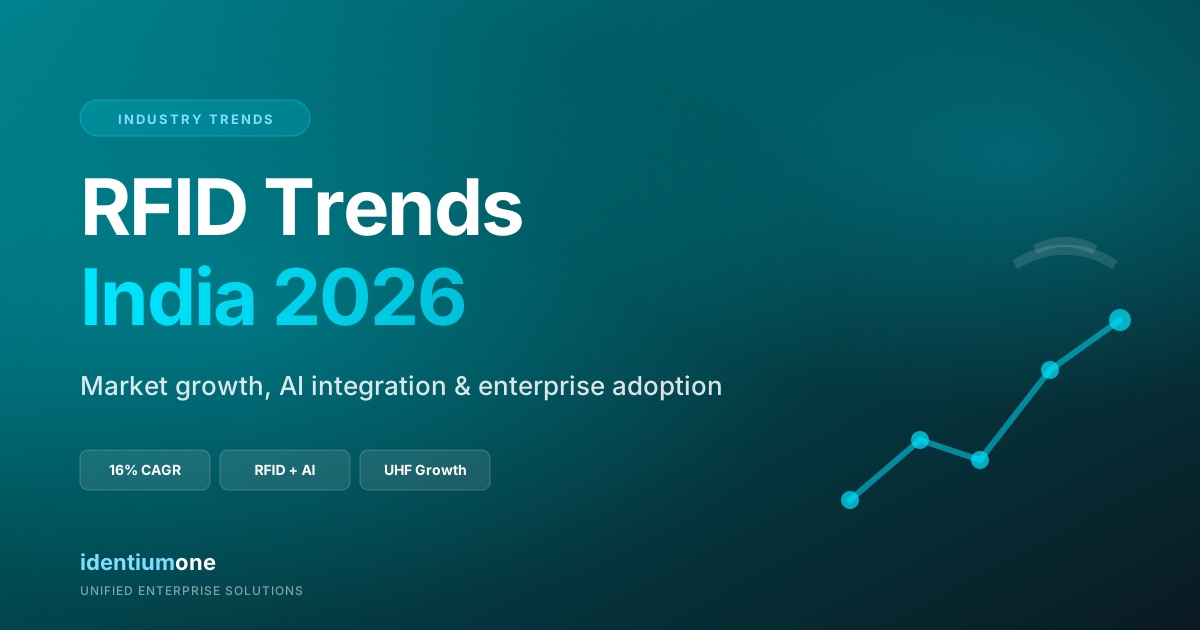
Industry analysts estimate India's RFID market at around USD 1.8 billion in 2026, projected to reach roughly USD 7 billion by 2035 — a compound annual growth rate of about 16%. That puts India at the upper end of, or slightly ahead of, the global RFID market, which market research indicates is growing at roughly 14–16% CAGR. In other words, India is not catching up to global RFID adoption — it is one of the markets pulling the global average up.
| Indicator | 2026 status |
|---|---|
| India RFID market size (2026) | ~USD 1.8 billion (industry analyst estimates) |
| Projected India market size (2035) | ~USD 7 billion |
| India growth rate | ~16% CAGR |
| Global RFID growth rate | ~14–16% CAGR |
| Fastest-growing frequency band | UHF (860–960 MHz) |
| Fastest-adopting vertical | Apparel & fashion retail |
Two structural facts shape this market. First, UHF (860–960 MHz) is the fastest-growing RFID frequency in India, because it delivers what enterprise deployments need: long read range, bulk reads of hundreds of tags per second, and fast data transfer. (If you're still deciding between bands, our UHF vs HF vs NFC comparison guide breaks down when each one wins.) Second, apparel and fashion retail is the fastest-adopting segment — large retailers such as Reliance Retail and Flipkart have begun deploying RFID in their distribution centres to drive inventory accuracy, and that scale of adoption pulls the entire supplier ecosystem along with it.
What's driving RFID adoption in India
Four forces converged to make 2026 an inflection year for RFID in India:
- The National Logistics Policy. India's push to cut logistics costs and digitise the supply chain rewards technologies that create item-level visibility. RFID is the most practical way to know — automatically, without line-of-sight scanning — what is inside a carton, a truck, or a warehouse.
- The Smart Cities Mission. Smart city programmes are normalising RFID in public infrastructure — vehicle identification, waste management, utility asset tracking — which builds local integration expertise and drives down deployment costs for private enterprises. Waste is the most procurement-ready of the three today: see our guide to RFID waste management for Indian municipalities and the RFID waste management system behind it.
- The PLI scheme and domestic manufacturing. The Production Linked Incentive scheme is boosting domestic manufacturing of RFID tags and readers. Locally produced inlays and hardware mean shorter lead times, lower landed costs, and less exposure to import cycles — all of which improve project ROI for Indian buyers.
- Organised retail expansion. India is in the middle of a major expansion of organised retail and mall space. Every new large-format store increases the pressure for SKU-level inventory accuracy, omnichannel fulfilment, and loss prevention — three problems RFID solves better than any alternative.
Layered on top of these is the 2026 technology shift itself: the convergence of RFID with AI, the emergence of chipless and ultra-low-cost tags, and much tighter integration between RFID middleware and enterprise ERP/WMS platforms. We cover each below.
Vertical by vertical: where Indian enterprises are deploying RFID in 2026
1. Apparel & fashion retail — the flagship vertical
Fashion is where Indian RFID adoption is moving fastest. Reliance Retail and Flipkart deploying RFID in distribution centres signals the same ecosystem effect the Walmart mandate created in the US: once anchor retailers demand tagged merchandise, source-tagging becomes the norm and per-store economics improve for everyone. The use cases are proven — SKU-level inventory counts in minutes instead of days, smart fitting rooms, faster omnichannel fulfilment, and exit-gate loss prevention. Identium's RFID apparel and fashion retail system covers this full stack, and pairs naturally with an RFID retail loss prevention system at store exits. For a deeper dive into the retail side, see our guide on how RFID is transforming retail in India.
2. Warehousing, inventory & logistics
Warehousing is the second engine of Indian RFID growth, propelled directly by the National Logistics Policy and e-commerce fulfilment volumes. Dock-door portals read entire pallets without unpacking, cycle counts become continuous rather than quarterly, and shipping errors get caught before the truck leaves. An RFID warehouse management system handles inbound, putaway, picking and dispatch, while an RFID inventory management system keeps stock-level truth across sites. For goods in motion, an RFID logistics and supply chain system extends that visibility from factory gate to final delivery hub. If you're building the business case, our RFID warehouse ROI guide walks through the payback math. For the transit half of the problem — gate-out, checkpoint and delivery-hub reads — see our guide to RFID in logistics and supply chain in India.
3. Jewellery
Indian jewellery retail is uniquely suited to RFID: high item value, strict daily audit culture, and thousands of visually similar pieces. A tagged showroom completes a full stock audit in minutes with a piece-by-piece trail, transforming both shrinkage control and billing speed. An RFID jewellery management system is now standard consideration for any chain or large independent showroom modernising in 2026. The implementation questions specific to gold — tying each tag to its HUID, tag antennas that survive a metal mount and how a tray count is set up — are covered in our guide to RFID for jewellery showrooms in India.
4. Hospitals & healthcare
Indian hospitals are adopting RFID for patient safety and asset utilisation. Wristband-based RFID patient tracking reduces identification errors and gives staff real-time location of patients, while tagged equipment — infusion pumps, wheelchairs, monitors — stops the daily hunt for mobile assets and cuts unnecessary duplicate purchases.
5. Commercial laundry
Hotels and hospitals lose a startling share of linen every year to miscounts and disputes with laundry vendors. Heat- and wash-resistant UHF tags turn every towel, sheet and uniform into a countable asset across hundreds of wash cycles. An RFID laundry management system automates check-in/check-out between property and plant, making loss visible and billing indisputable. Our linen and laundry tracking guide covers tag selection for wash cycles and how the plant-versus-property count dispute actually gets settled.
6. Livestock
Animal identification is a growing RFID category in India, spanning dairy herd management, disease-traceability programmes and insurance verification. An RFID livestock tracking system gives farms and government programmes a tamper-resistant digital identity for every animal. Our guide to RFID livestock tracking in India covers ear-tag standards, Pashu Aadhaar registration and what dairy records need from the tag.
7. Enterprise asset tracking
Across IT parks, factories and offices, fixed-asset registers maintained in spreadsheets rarely survive contact with an audit. Tagging laptops, tools, dies, moulds and furniture with an RFID asset management system converts the annual physical-verification ordeal into a walk-through scan — and satisfies auditors with timestamped evidence. The same campuses usually tag people and vehicles at the same time: an RFID access control and attendance system at the door and an RFID vehicle and parking management system at the boom barrier, both covered in our attendance and access control guide.
RFID + AI: the defining trend of 2026
The most important RFID trend in India in 2026 is not a new tag or reader — it is what happens to the data after the read. RFID deployments generate continuous, item-level event streams, and enterprises are now feeding those streams into AI models in three ways:
- Predictive analytics. Read histories train demand-forecasting and replenishment models. Instead of reacting to a stockout, the system predicts it — per SKU, per store, per season.
- Real-time visibility. AI-assisted dashboards fuse reads from portals, handhelds and fixed readers into a single live picture of inventory position across the supply chain, so planners act on what is true now rather than what the ERP said last week.
- Anomaly detection. Machine learning flags patterns humans miss: items moving toward exits without billing, stock dwelling too long in a receiving zone, tag populations that shrink between counts. This is loss prevention and process control running continuously in the background.
Two supporting technology shifts round out 2026. Chipless and low-cost tags are pushing tagging economics down toward price points where low-value FMCG items become viable to tag, widening the addressable market. And ERP/WMS integration is becoming table stakes — buyers no longer accept RFID as an island; reads must flow directly into SAP, Oracle, Tally-adjacent stacks or custom WMS platforms as inventory transactions. Identium builds this integration layer into every deployment, because RFID data that never reaches the system of record is just noise.
Going deeper: for the full technical treatment of this trend — the data an RFID deployment actually produces, the reader-to-model pipeline, demand forecasting, sensor fusion, anomaly detection, and an honest look at where a simple rule beats machine learning — read our dedicated guide to RFID and AI integration in India.
How Indian enterprises should start with RFID in 2026
The playbook that works in the Indian market is disciplined and small-before-big:
- Pick one site and one problem. Your highest-shrink store, your most error-prone warehouse, your slowest audit. A focused pilot produces defensible numbers; a broad one produces anecdotes.
- Choose the right frequency for the job. For most inventory, warehouse and retail use cases in India, UHF (860–960 MHz) is the correct default — it is the fastest-growing band here for a reason. Reserve HF/NFC for payments, access and item-authentication cases.
- Test tags on your actual items. Metal, liquids, dense packing and Indian warehouse conditions (heat, dust, humidity) all affect read performance. Site surveys and tag testing before purchase are the single cheapest way to prevent a failed project.
- Run the pilot for 8–12 weeks and measure. Inventory accuracy before and after, audit time before and after, shrinkage trend. These three numbers make or break the board approval for rollout.
- Integrate before you scale. Connect reads to your ERP/WMS during the pilot, not after rollout. Integration issues discovered after a 50-site rollout cost many times what they cost at one pilot site.
- Work with an India-based partner. Local hardware availability, GST-compliant supply, Hindi/regional-language training and on-ground support matter as much as the technology. Identium delivers end-to-end — tags and readers through IndiaRFIDStore.com, software built in-house, and deployment teams based in New Delhi.
Frequently asked questions
How big is the RFID market in India in 2026?
Industry analysts estimate India's RFID market at around USD 1.8 billion in 2026, projected to reach roughly USD 7 billion by 2035 — a compound annual growth rate of about 16%, at or above the global RFID market's 14–16% CAGR.
Which industry is adopting RFID fastest in India?
Apparel and fashion retail is the fastest-adopting RFID segment in India. Large retailers such as Reliance Retail and Flipkart have begun deploying RFID in their distribution centres for inventory accuracy, with warehousing, jewellery, healthcare and logistics following closely behind.
Which RFID frequency is growing fastest in India?
UHF RFID (860–960 MHz) is the fastest-growing frequency band in India. It offers long read range, bulk reading of hundreds of tags at once, and fast data transfer — making it the default choice for retail inventory, warehousing and supply chain applications.
How is AI being combined with RFID in 2026?
In 2026, enterprises feed real-time RFID read data into AI models for predictive analytics (demand and replenishment forecasting), real-time inventory visibility across sites, and anomaly detection — automatically flagging shrinkage, misplaced stock and unusual movement patterns.
What government policies are driving RFID adoption in India?
The National Logistics Policy, the Smart Cities Mission, and the PLI (Production Linked Incentive) scheme — which is boosting domestic manufacturing of RFID tags and readers — are the main policy drivers, alongside rapid expansion of organised retail and mall space.
How should an Indian enterprise start with RFID in 2026?
Start with a focused pilot: pick one high-impact site, tag one product category or asset class, measure inventory accuracy and audit-time savings over 8–12 weeks, and integrate reads with your ERP or WMS before scaling. An experienced India-based integrator like Identium can run the pilot end to end, from tag selection to software integration.