The Interface
28 Modules, All Running on the Reader
Real screens from the product — Monitor, Assets, Intelligence, Configure, System, Connect and Admin groups.
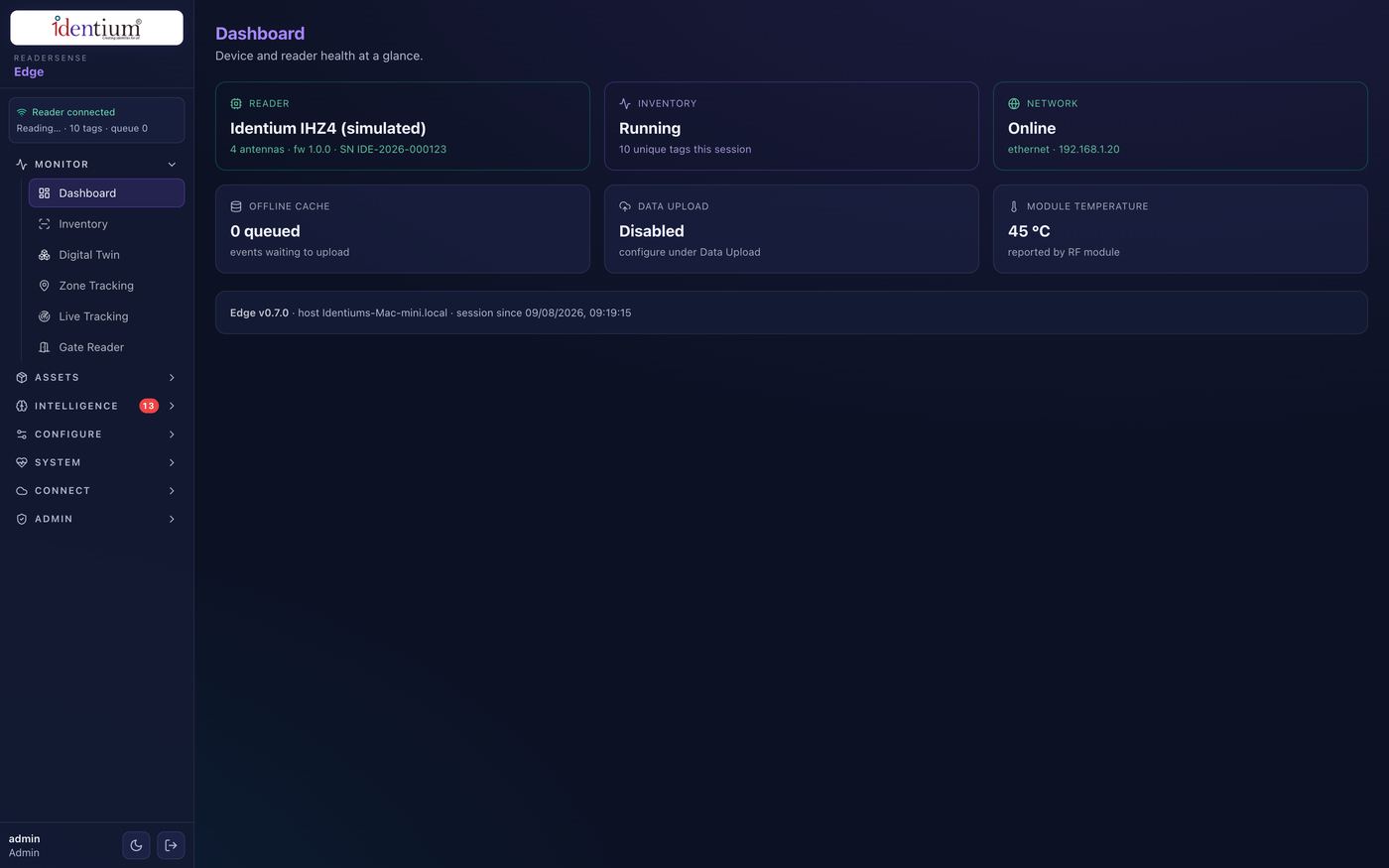
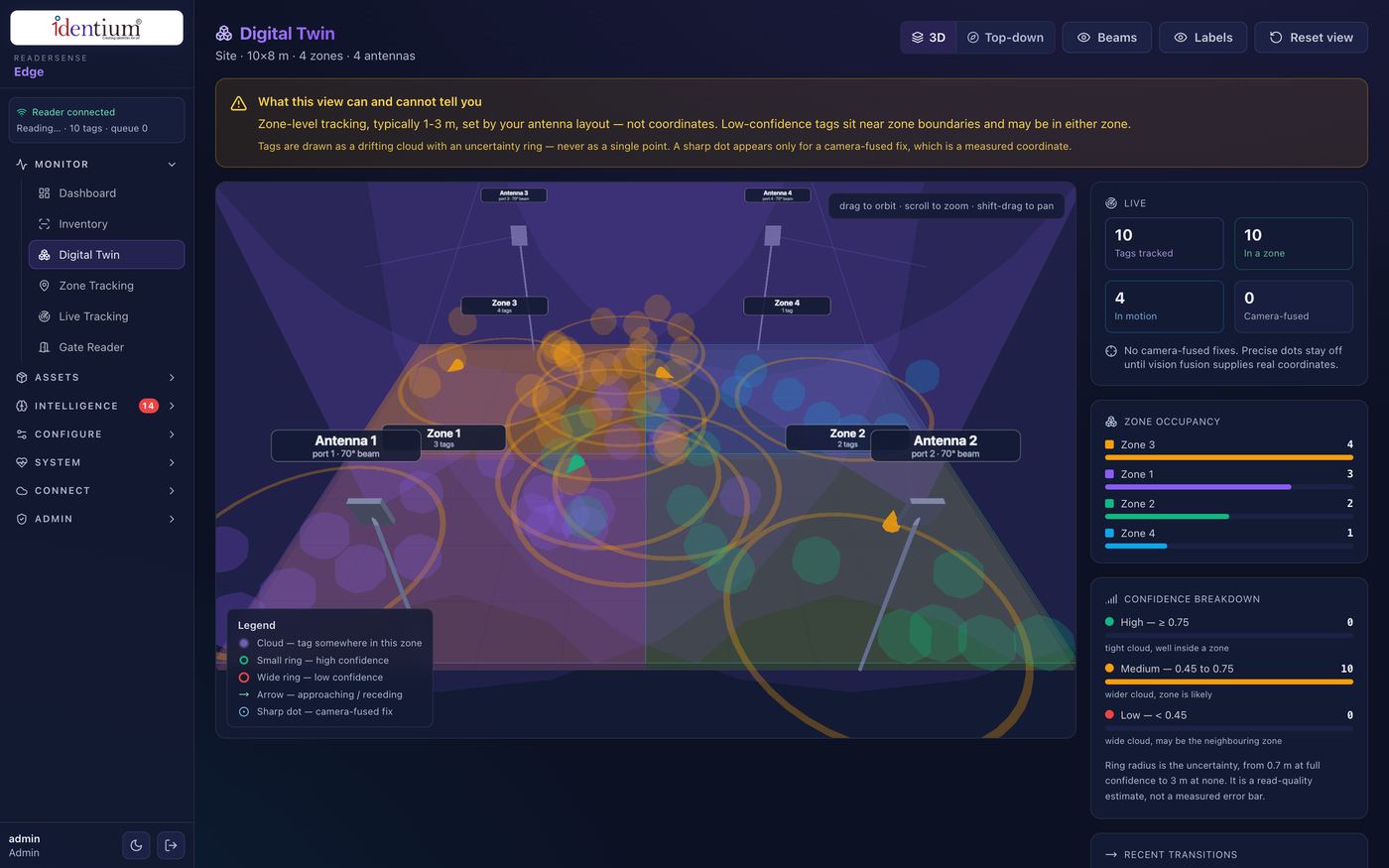
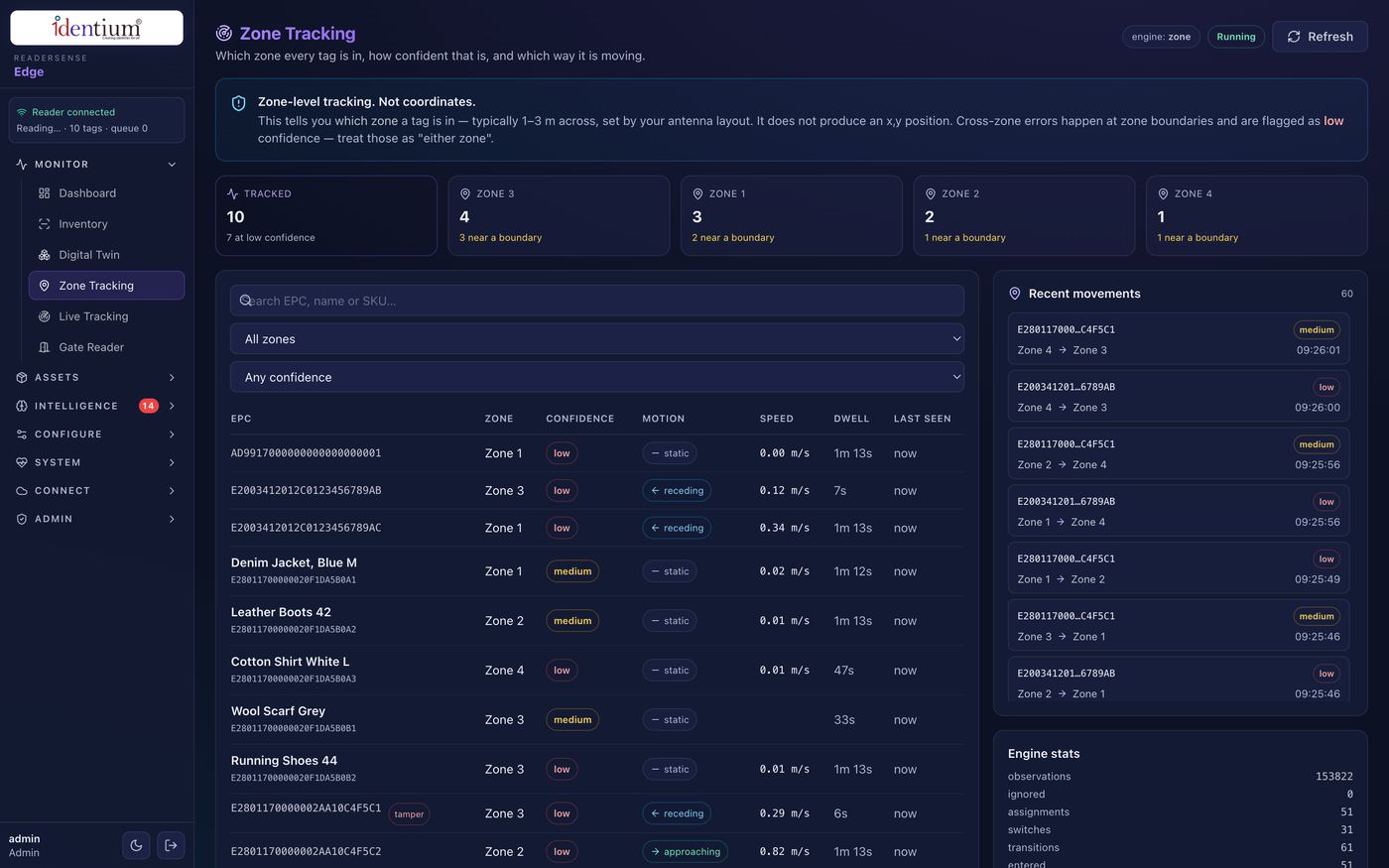
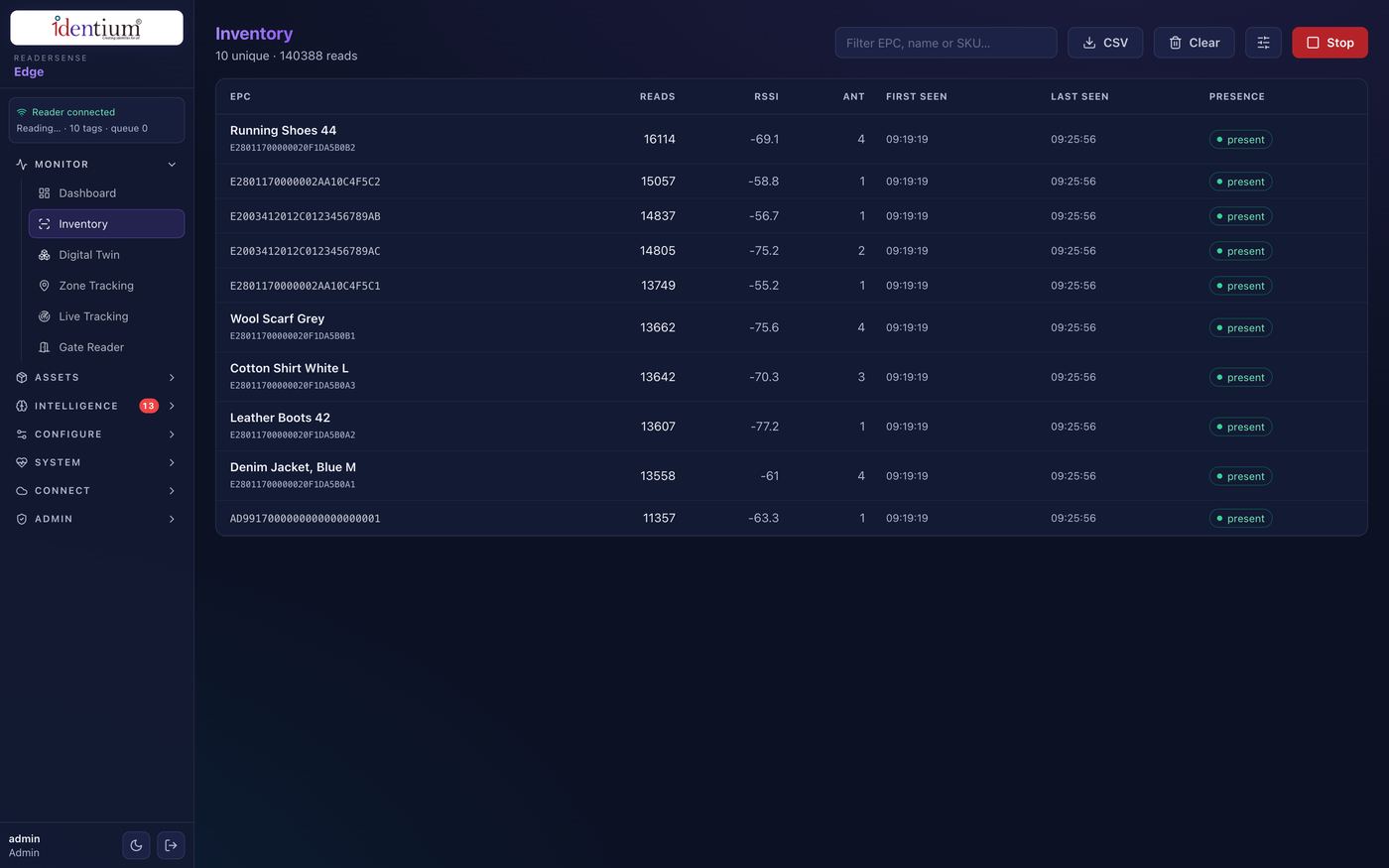
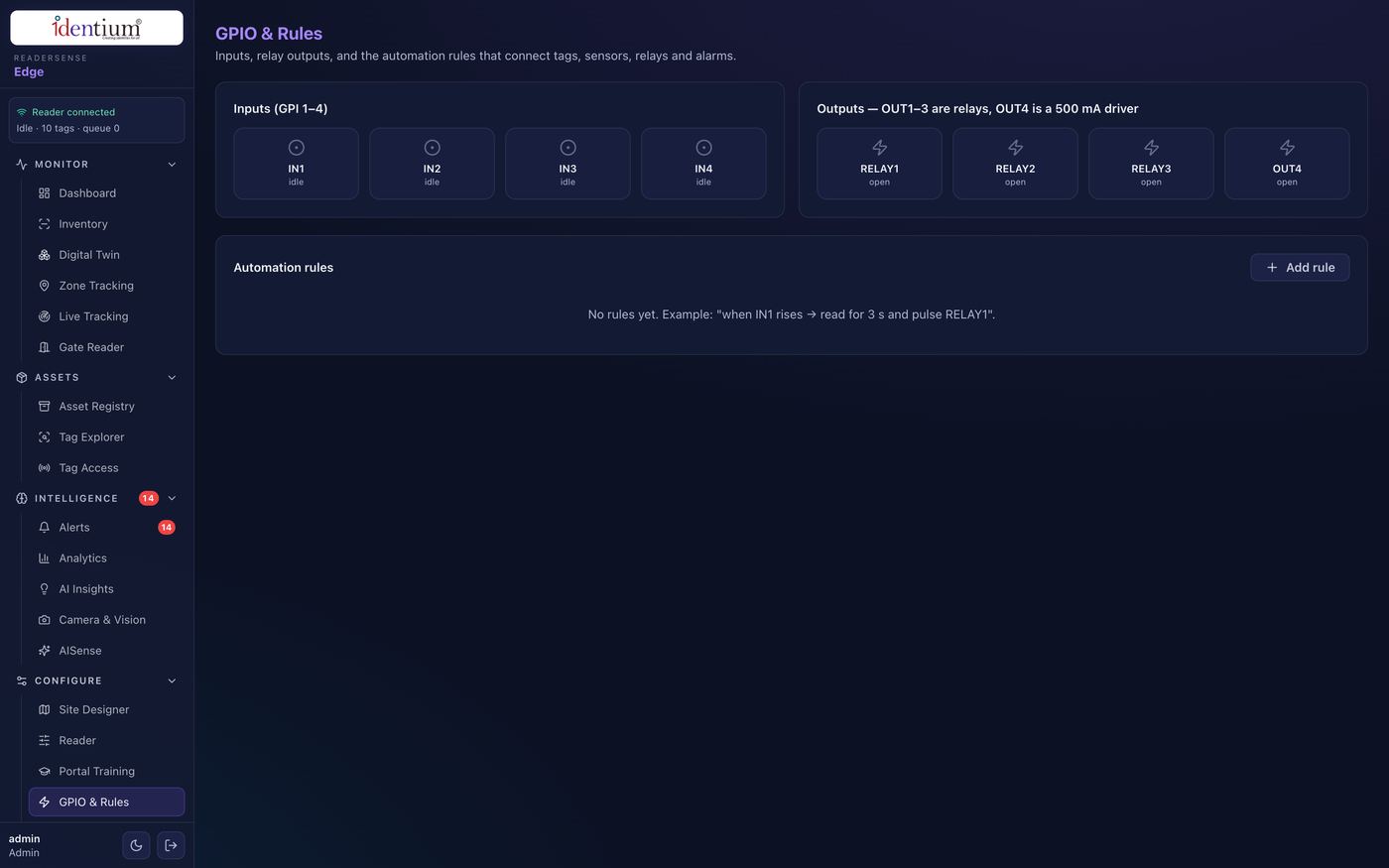
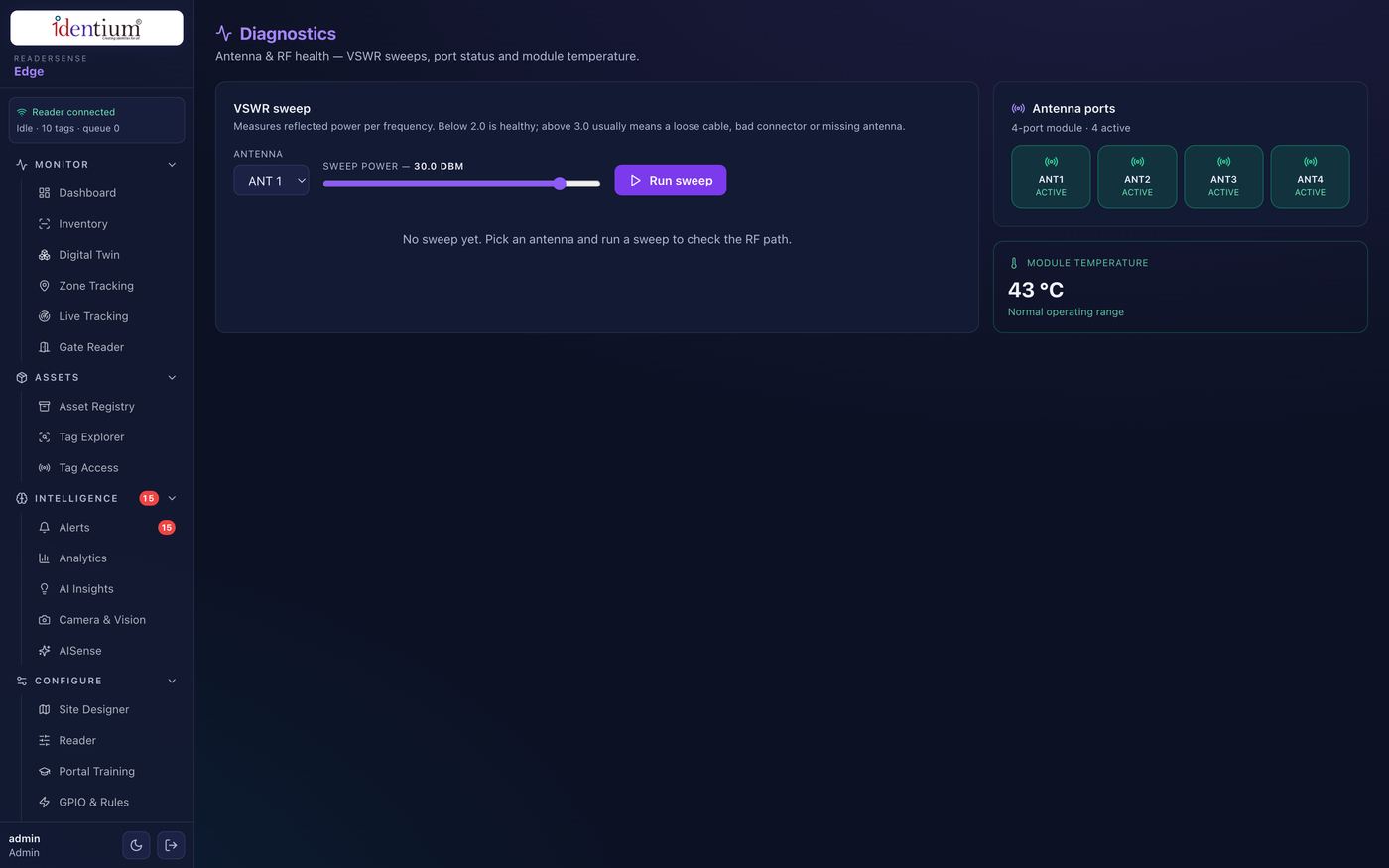
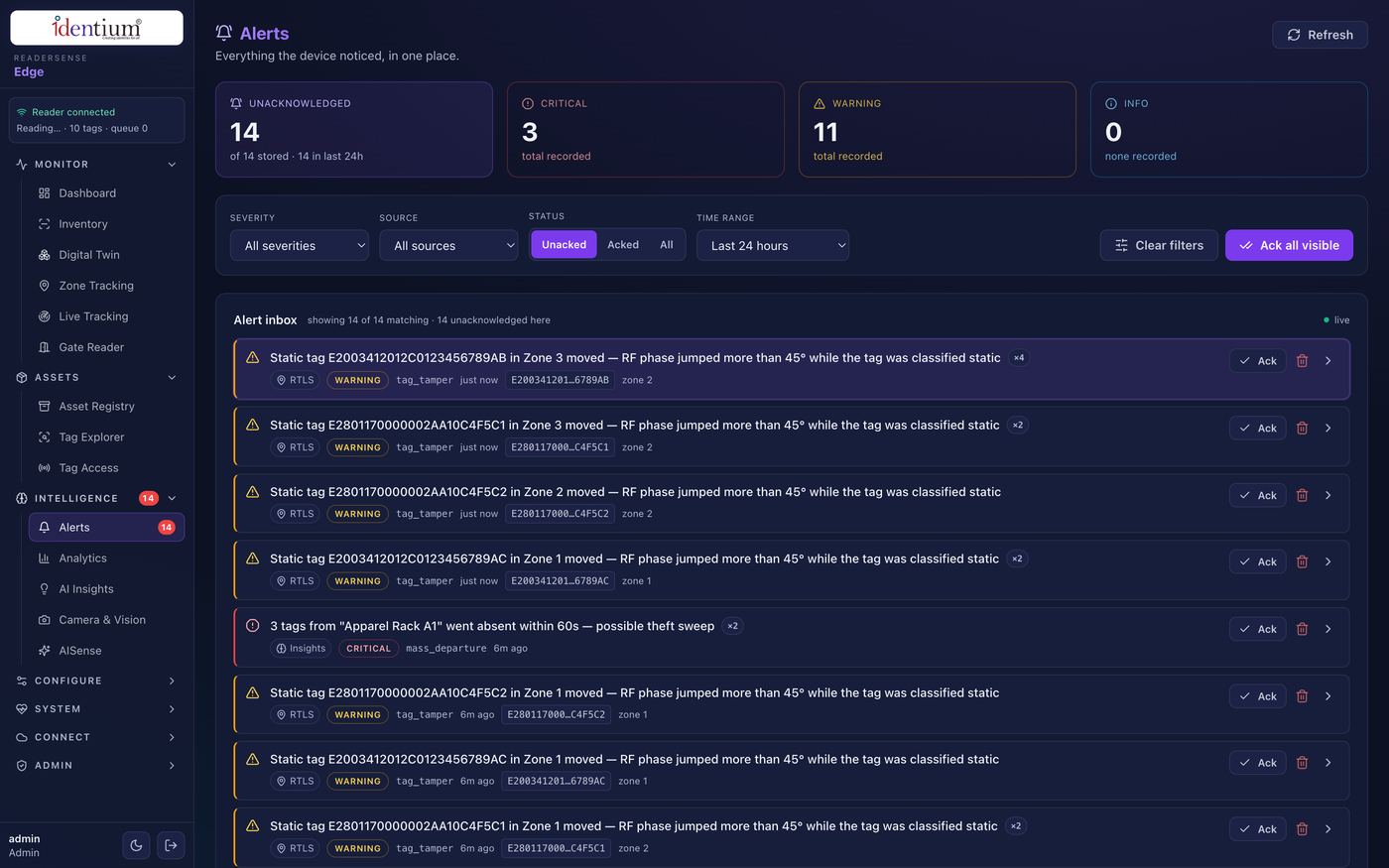
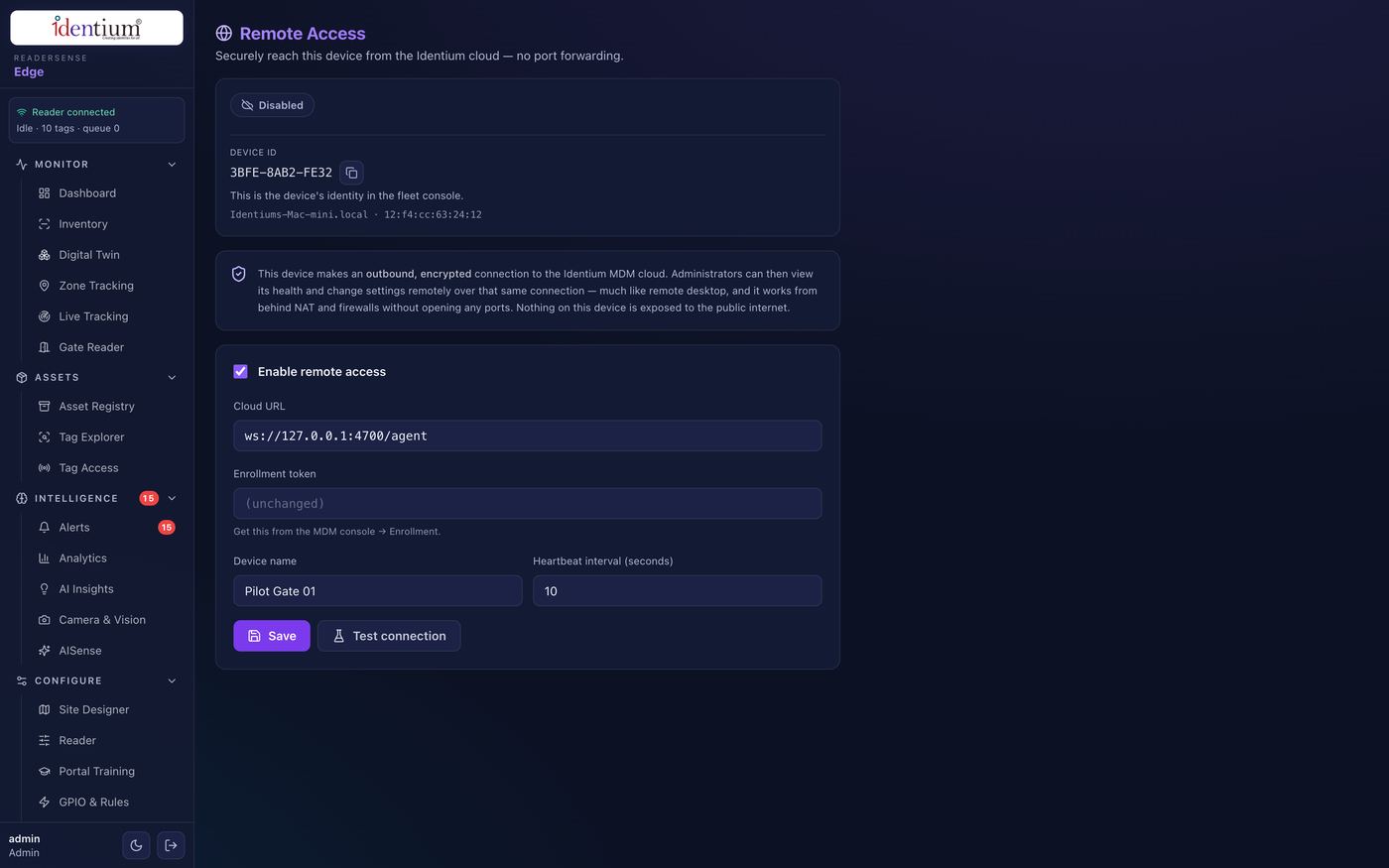
ReaderSense Edge is RFID middleware that runs on the reader — industrial Linux inside the device, a full browser interface on its own address, every read stored locally, and rules, alerts and I/O that keep working when the network does not. ReaderSense MDM is one cloud console for the whole fleet, reached without opening a single inbound port.
Recorded on the actual product: the on-reader interface, then the fleet console reaching into it.
Every conventional RFID deployment has a PC or a server in the loop between the reader and the business. That box is the thing that gets unplugged, runs out of disk, loses its Windows update fight, or sits in a cupboard nobody can reach. Edge removes it.
Boots with the device and serves its own interface on port 80. Any laptop or phone on the LAN opens it. No installer, no client software, no PC on site.
Every read is written to SQLite on the board’s eMMC. Network loss and reboots do not lose events; the queue drains in order when the link returns.
An input edge or a tag event pulses a relay, sounds an alarm pattern, triggers a read burst or calls a webhook — with the cloud up or down.
HTTP or WebSocket upload with store-and-forward, MQTT with TLS and last-will, RS485 Modbus RTU for scales, PLCs and barriers. Nothing requires an Identium account.
The Digital Twin and Zone Tracking screens carry “what this can and cannot tell you” banners. Where the signal will not support a number, none is shown.
Each unit is licensed to its own hardware identity with a signed key. Multi-user roles, forced first-login password change, and a full audit trail.
Every device sits behind a customer’s NAT with no public IP. Instead of us dialling in, each reader dials out to the MDM hub and holds an encrypted WebSocket open. The hub routes operator requests back down that already-open tunnel — the same technique remote-desktop tools use, so it works from any network that can make an outbound HTTPS connection.
Online/offline, firmware, tag throughput and telemetry history for every enrolled reader, in one place.
Open any device’s own interface from the console — screen, shell, files, config — through its existing outbound tunnel.
Scoped, time-boxed enrolment tokens. Revoke one device without touching the rest. Every remote action attributed in both the hub log and the device audit trail.
Real screens from the product — Monitor, Assets, Intelligence, Configure, System, Connect and Admin groups.
Locationing claims in this market are often not. Here is exactly what Edge reports, and what the physics of panel antennas in the 865–868 MHz band will never support.
| Capability | Supported | Basis |
|---|---|---|
| Zone-level tag tracking | Yes | 1–3 m, set by antenna layout |
| Direction of travel and radial speed | Yes | Derived from RF phase |
| Camera-fused position | Yes | Within the camera field of view only |
| Item coordinates across a whole floor | No | Requires a phased-array reader |
| Angle-of-arrival positioning | No | Panel antennas exceed the required element spacing |
| Phase ranging in the 865–868 MHz band | No | Band is too narrow to resolve distance |
Edge ships on the Linux interface board inside Identium fixed readers — the same readers behind our warehouse gates, production stations and store exits.
Quad-core ARM64 · Linux · 2 GB RAM · eMMC storage, built into the reader. No display connector — the browser is the display.
RJ45 · optional 4G / 5G / Wi-Fi · RS232 + RS485 · 2× USB host (camera, sensors, storage).
4 isolated inputs (GPI) + 4 outputs (GPO): 3 relays 0.3 A / 50 VAC or 1 A / 30 VDC, one 500 mA driver. Light barriers, barriers, stack lights, PLC handshakes.
Edge reuses the desktop ReaderSense module bridge on the board, so the reader behaves identically whether an operator drives it from a PC or it runs on its own.
On-device RFID middleware that runs on the reader's own Linux interface board. It boots with the device, drives the RF module, stores every read locally in SQLite, and serves a full browser interface on the reader's own address — live inventory, zone tracking, asset registry, alerts, rules and diagnostics — with no PC, no installer and no cloud required for the reader to do its job.
MDM is the cloud half. Edge runs on each reader; MDM is one console at mdm.identiumone.com that shows every enrolled reader — online/offline, health, tag throughput — and lets an operator open a live session onto any device's own interface, push config, or update firmware. Each device dials out to MDM over an encrypted WebSocket, so nothing inbound is ever opened on the customer's network.
Yes. Tag capture, rules, alerting and the local cache all continue through an outage. Events queue on the device's storage, survive reboots, and drain in order when the link returns. Alerts raised offline are still in the inbox afterwards. The cloud is for management and reach, not for the reader to function.
No, and we say so on the screen. Standard panel antennas in India's 865–868 MHz band cannot resolve item coordinates, angle-of-arrival or phase ranging — the band is too narrow and the antennas are physically wider than the required element spacing. What Edge does report is the zone a tag is in (typically 1–3 m, set by antenna layout) with a confidence grade, its direction of travel and radial speed, and — inside a camera's view — a fused position. Where the signal will not support a number, none is shown.
The industrial Linux interface board built into Identium's fixed readers: a quad-core ARM64 processor, 2 GB RAM, eMMC storage, RJ45 with optional 4G/5G/Wi-Fi, RS232/RS485, two USB hosts, four isolated inputs and four relay/driver outputs. It has no display connector — the browser interface is the display.
Three built-in outbound paths: Data Upload (HTTP or WebSocket, batched, store-and-forward), IoT Hub (MQTT with TLS, last-will and retained status), and webhooks fired from the rules engine. Plus RS485 Modbus RTU for scales, PLCs and barriers, and the standard reader protocol for the desktop ReaderSense app. Nothing requires an Identium cloud account.
Pilot one Edge reader on one gate for a month — watch it run through a network outage, then reach into it from MDM without touching your firewall.