Active vs Passive RFID: When to Use Which
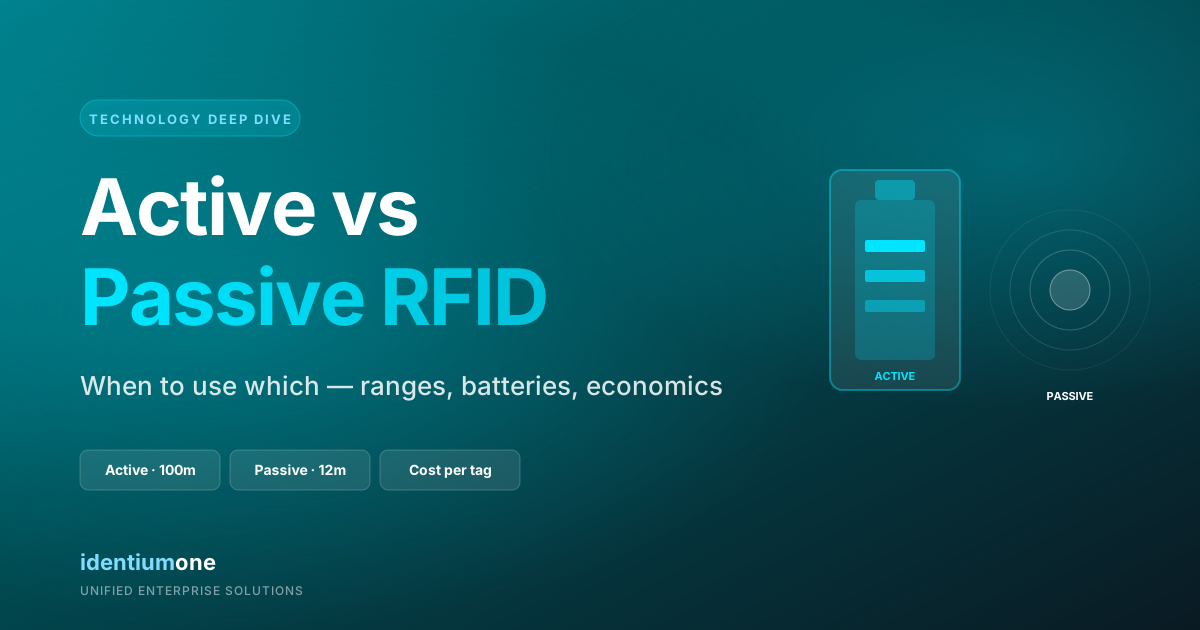
When people say "RFID", they almost always mean passive RFID — the disposable sticker inlay on your Zara hang-tag. But active RFID is a completely different animal, and the cost delta between them is 50× per tag. Picking the right one is one of the highest-leverage decisions in an RFID deployment. This post is the framework we use.
The core difference in one sentence
Passive tags have no battery and are powered by the reader's radio signal. Active tags have their own battery and broadcast on their own. Everything else — range, cost, size, lifetime — follows from that one fact.
Full comparison
| Property | Passive UHF | Active RFID |
|---|---|---|
| Read range | Up to 12 m | Up to 100 m+ |
| Battery | None | Lithium; datasheets commonly quote 3 years |
| Tag cost | ₹6 – ₹200 | ₹400 – ₹3,000+ |
| Size | Sticker to matchbox | Soap-bar to small-brick |
| Tag count per reader | 1,000+ per second | Hundreds concurrent |
| Broadcast initiation | Reader-initiated only | Tag can transmit autonomously |
| Temperature sensing | Rare / add-on | Built-in common |
| Typical use case | Retail, warehouse, library | RTLS, high-value assets, outdoor tracking |
When passive wins
Passive is the right choice when any of these apply:
- You tag many items (1,000+). At ₹10/tag, tagging 100,000 SKUs is ₹10 lakh — affordable. Active RFID at ₹2,000/tag would be ₹20 crore. Not viable.
- Items don't need tracking when out of reader range. In a warehouse, a pallet only needs identification when it passes a gate — passive is perfect.
- Tags go out of your control (to customers, to disposal). You'd never hand out ₹2,000 battery tags — they'd be lost or end up in landfill.
- You need tag form factors like hang-tags, inlays, or labels. Passive tags can be sticker-thin. Active can't.
So: retail inventory, warehouse, apparel, library, general asset tracking, laundry. Always passive.
When active wins
Active earns its price premium when any of these apply:
- Range > 15 m. Passive caps at ~12 m. Tracking forklifts in a 200 m warehouse, or equipment on a 5-acre construction site? Active.
- Outdoor, open-sky tracking. Passive struggles with distance and reflections outdoors; active works to 100 m routinely.
- Continuous RTLS (real-time location). When you need to know where a ₹50 lakh MRI machine is, right now, not just when it passes a gate. Passive is "last seen at X, 3 hours ago." Active is "currently in Zone 4, heading towards Zone 6."
- Few high-value items. 200 active tags on 200 hospital infusion pumps or aviation tools is affordable — and the asset value justifies it.
- Environmental sensing. Active tags routinely carry temperature, humidity, shock, or tamper sensors with on-tag logging.
So: active reader tracking, hospital equipment RTLS, long-range vehicle identification, cold-chain monitoring, construction site asset tracking, personnel safety (lone worker). Evacuation mustering is the clearest case where only an active tag will do — see our RFID mustering and evacuation roll call system.
The hybrid pattern
Most sophisticated deployments use both. A typical hospital rollout:
- HF/UHF passive wristbands for every patient (high volume, disposable)
- UHF passive tags on consumable items and medication packs
- Active tags on 200 critical mobile assets: crash carts, ventilators, infusion pumps, ultrasound machines
Same reader infrastructure can usually handle both, so there's no double-spend on readers.
The battery question
The biggest operational concern with active is battery management. Good active tags give you:
- Around three years of battery life under a typical duty cycle — check the datasheet, not the brochure
- A low-battery flag exists in most active protocols — but confirm the platform actually decodes and alerts on it
- Field-replaceable batteries (some models)
Plan for battery replacement as a known cost — roughly ₹100–₹300 per tag every 4 years. For a fleet of 500 active tags, that's about ₹1 lakh every 4 years. Budget it.
Semi-passive / battery-assisted passive (BAP)
A third category worth knowing about: BAP tags. They have a small battery that boosts the return signal, but only transmit when queried by a reader. You get 30–40 m range at roughly ₹300/tag. Useful for the middle ground — vehicle toll tags, certain cold-chain applications.
FASTag (the Indian highway toll system) uses BAP-style UHF tags. Our own vehicle parking solution uses passive UHF for most gate applications — BAP only for long-range highway-style lanes. Our guide to RFID parking and vehicle access in India works through where each of those belongs: society gates, campus lanes and FASTag interoperability.
The decision tree
- How many items? > 1,000 items → passive. < 500 high-value items → consider active.
- What read range? < 12 m → passive. > 15 m → active.
- Do you need continuous location or event-based? Continuous → active. Event-based (pass-a-gate) → passive.
- Do you need environmental data (temp, shock)? Yes → active (or specialty passive sensor tags).
- Budget per item? < ₹100/tag → passive. > ₹500/tag acceptable → active is an option.
Practical examples
Warehouse inventory: passive — thousands of SKUs, event-based gate reads, low budget per tag.
Hospital equipment tracking: mostly active — few hundred high-value mobile assets that need continuous location.
Car parking: passive UHF for gate access (windshield tags work at up to 10 m).
Construction site: active for high-value tools; passive for bulk materials.
Event wristbands: passive — disposable, low cost, event-based reads.
Office doors and attendance: passive HF/NFC cards — nothing to charge on a turnstile running 12-hour shifts. See our access control and attendance solution and the India deployment guide.
Buying readers
Active RFID uses different readers than passive UHF. Common readers on our platform support both: see handhelds and gate readers. For pure active RTLS deployments, we spec dedicated active reader clusters — which ship as part of our active reader tracking solution.
Still unsure? Default to passive.
If you don't have a clear reason that requires active — pick passive. It's cheaper, simpler, mature, and the tag ecosystem is vast. Add active later if specific use cases emerge. The other way round (starting active, stepping down to passive) is expensive and rare.
Need help sizing your mix? Tell us the scenario — we'll recommend an active/passive split in one call.
Related reading: active RFID hardware: readers and beacon tags